

Land development is one of the highest-risk categories in real estate lending. Before a single shovel breaks ground, private money lenders must decide exactly how much capital they are willing to extend relative to the land's value. That decision hinges on the loan-to-value (LTV) ratio—and for land deals, the math is far more nuanced than a standard home purchase.
This guide breaks down every factor private lenders weigh when setting a maximum LTV for land development projects, compares the key valuation metrics they use, and offers concrete strategies borrowers can employ to secure better terms.
What Is LTV and Why It Matters for Land Deals
The loan-to-value ratio expresses the size of a loan as a percentage of the collateral property's value. You calculate it by dividing the loan amount by the appraised value and multiplying by 100. A $350,000 loan on land appraised at $500,000, for example, yields a 70% LTV.
Private money lenders treat LTV as their primary risk gauge. A lower ratio means a larger equity cushion—the borrower's own capital at stake—which gives the lender a greater margin of safety if the borrower defaults and the property must be liquidated. Because raw land and development parcels are inherently harder to sell quickly than finished homes, lenders demand significantly more cushion on these deals.
Typical LTV Ranges for Land and Development Loans
Not all land is created equal in a lender's eyes. The stage of development dramatically affects the maximum LTV a private lender will approve.
| Property Stage | Typical Private-Lender LTV | Risk Rationale |
|---|---|---|
| Raw, unentitled land | 35%–50% | No improvements, uncertain entitlements, illiquid |
| Entitled land (approved plans, permits) | 50%–60% | Reduced regulatory risk, clearer path to development |
| Land under active development (grading, utilities) | 55%–65% | Tangible progress increases collateral value |
| Finished lots ready for vertical construction | 60%–75% | Near-term revenue potential, easier to sell individually |
Hard money lenders generally cap LTV between 60% and 75% across all property types, with the majority topping out around 70%. Raw land, however, sits at the low end of that spectrum—often below 50%—because it lacks improvements and has limited resale demand.
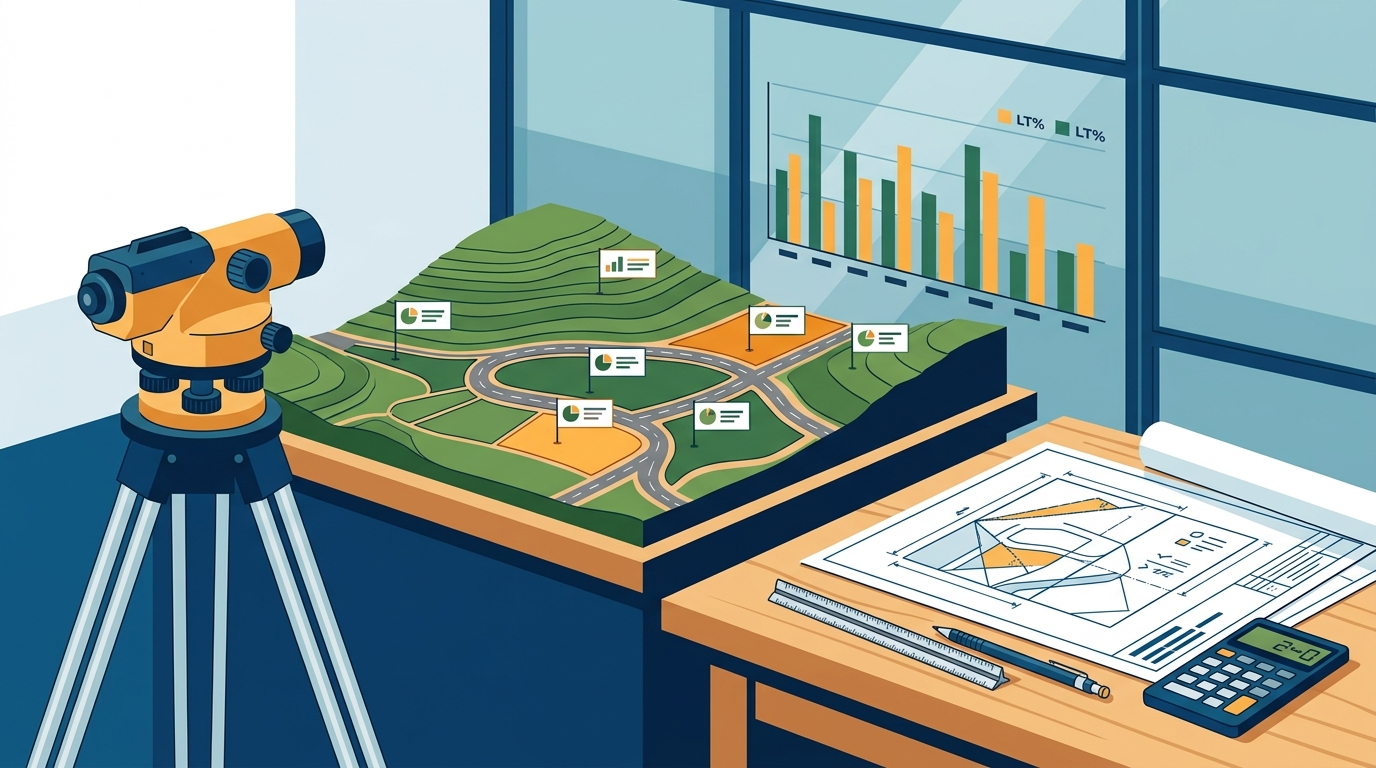
How Private Lenders Value Land: Three Approaches
The LTV ratio is only as meaningful as the value in the denominator. Private lenders may use one or more of the following valuation methods, and the choice significantly influences maximum loan proceeds.
1. As-Is Market Value
This is the land's current appraised value based on comparable sales of similar parcels in the area. It is the most conservative basis and is standard for acquisition-only loans where no development has begun.
2. As-Entitled or As-Developed Value
If entitlements (zoning approvals, subdivision maps, grading permits) are in place, the land may be appraised at a higher value reflecting the reduced regulatory risk. Lenders who use this figure can offer somewhat higher loan amounts while maintaining the same LTV percentage.
3. After-Completion Value (LTCV)
For projects with a clear build-out plan, some private lenders base LTV on what the finished product—subdivided lots or completed structures—will be worth. This parallels the after-repair value (ARV) concept common in fix-and-flip lending. Because the denominator is larger, borrowers can access more capital even at a conservative LTV percentage. However, lenders demand strong documentation, third-party appraisals, and borrower track records before using this approach.
Seven Risk Factors That Move the LTV Needle
Private lenders don't pull an LTV number from a chart. They adjust their maximum ratio up or down based on a layered risk assessment. Here are the seven most influential variables:
Factor 1: Location and Market Demand
Land in a metro area with strong population growth and housing demand will command a higher LTV than a remote rural parcel. Lenders evaluate absorption rates—how quickly finished lots or homes sell in the submarket—to determine exit risk.
Factor 2: Entitlement Status
Entitlements represent months or years of regulatory work already completed. A fully entitled parcel eliminates a major source of project delay and cost overruns, justifying a higher LTV. Conversely, raw land requiring rezoning can push the maximum LTV below 40%.
Factor 3: Environmental and Physical Conditions
Phase I and Phase II environmental assessments, flood zone classification, soil reports, and topography all factor in. Contamination risk, steep slopes, or wetlands can reduce the effective LTV or disqualify the property entirely.
Factor 4: Borrower Experience and Track Record
A developer who has completed multiple successful subdivisions poses less execution risk than a first-time land investor. Experienced borrowers may receive LTV offers five to ten percentage points higher than newcomers on comparable properties.
Factor 5: Project Feasibility and Budget
Lenders scrutinize the development pro forma: total project cost, infrastructure budget, projected lot sale prices, and timeline. A well-documented, conservative budget increases lender confidence and can push LTV upward. Overly optimistic projections have the opposite effect.
Factor 6: Exit Strategy
How will the loan be repaid? Common exits include lot sales, a construction take-out loan, or refinancing into permanent financing. The more certain and diversified the exit, the more comfortable a lender is extending a higher LTV.
Factor 7: Market Cycle and Interest Rate Environment
In periods of economic uncertainty, private lenders tighten LTV caps across the board. Credit conditions in the construction and development sector remained tight for fourteen consecutive quarters through mid-2025, with land development loan rates averaging 11.77%. When capital markets contract, even experienced borrowers may see lower LTV offers.
LTV vs. LTC vs. LTCV: Which Metric Applies?
Land development straddles the line between acquisition and construction, which means multiple leverage metrics come into play. Understanding the differences is critical for borrowers structuring a deal.
Loan-to-Value (LTV)
Loan amount divided by the property's current appraised value. Best applied to stabilized acquisitions or land purchases where no further improvement is planned immediately.
Loan-to-Cost (LTC)
Loan amount divided by total project cost (land acquisition plus all development expenditures). LTC becomes the dominant metric for development projects where the appraised value does not yet reflect planned improvements. A lender might fund 70% LTC on a $10 million total project cost—equaling $7 million—even if the raw land's current LTV-based loan amount would be much lower.
Loan-to-Completed Value (LTCV)
Loan amount divided by the projected value of the completed development. For ground-up construction, lenders use the term loan-to-completed value instead of after-repair value. This metric anchors the loan size to future value, which can significantly increase proceeds.
In practice, private lenders for land development often size the loan using the most conservative result of all three calculations. If LTV, LTC, and LTCV produce different loan amounts, the lowest figure typically wins.
Regulatory Benchmarks Private Lenders Reference
Although private money lenders are not bound by federal banking regulations in the same way that FDIC-insured institutions are, many use federal supervisory LTV limits as a starting framework. According to FDIC guidance, institutions may lend up to 65% of value for raw land and 75% for land development or finished lots. These caps serve as an industry reference point, even for non-bank lenders.
The key distinction: federal regulations require banks to use the lesser of purchase price or appraised value. Private lenders are free to choose the value they wish to use—and many opt for the higher appraised value or even after-completion value, which can result in larger loan proceeds despite a nominally lower LTV percentage.
Strategies to Improve Your LTV Offer
Advance Entitlements Before Applying
Securing zoning approvals, environmental clearances, and subdivision maps before approaching a lender transforms raw land into entitled land—immediately shifting you into a higher LTV tier.
Bring a Detailed Development Pro Forma
A comprehensive project budget that includes site work, infrastructure, soft costs, contingencies, and a realistic sales absorption schedule gives the lender confidence in your numbers and your competence.
Demonstrate Relevant Experience
Assemble a portfolio of past projects, including timelines, budgets versus actuals, and returns. Borrowers who can prove execution ability get better leverage terms.
Offer Additional Collateral or Cross-Collateralization
Pledging other owned properties or assets can effectively lower the lender's risk exposure on the land deal, sometimes pushing the allowable LTV higher.
Increase Your Equity Contribution
A larger down payment directly reduces LTV, which in turn can unlock lower interest rates and more favorable loan terms. For land development, down payments commonly range from 25% to 50% of total project cost.
Negotiate Based on Completed Value
If you have a strong track record and a credible appraisal supporting the after-completion value, ask the lender to size the loan against that figure rather than as-is value. This is where working with an experienced private lender who understands development projects pays dividends.
Key Takeaways
- Private money lenders typically cap LTV for land development between 50% and 75%, with raw land rarely exceeding 50%.
- The valuation basis—as-is, as-entitled, or after-completion—dramatically affects the loan amount even at the same LTV percentage.
- Seven primary risk factors (location, entitlements, environmental conditions, borrower experience, project feasibility, exit strategy, and market cycle) determine where your LTV falls within the range.
- LTV, LTC, and LTCV are all relevant metrics; lenders often size loans based on the most conservative result of all three.
- Federal supervisory limits (65% raw land, 75% land development) serve as industry reference points even for non-bank lenders.
- Borrowers can improve their LTV offer by advancing entitlements, presenting detailed pro formas, demonstrating experience, and increasing equity contributions.
Frequently Asked Questions
What is the typical maximum LTV for a private money land development loan?
Most private lenders offer between 50% and 75% LTV for land development, depending on the project's risk profile, the stage of entitlements, and the borrower's experience. Raw, unentitled land usually caps below 50%, while finished lots with clear demand can reach 65%–75%.
Do private lenders use after-completion value for land deals?
Some do, particularly for projects with approved plans and experienced developers. When using after-completion value (sometimes called loan-to-completed value), the effective loan amount can be higher because the denominator reflects the finished project's worth rather than the raw land's current market price.
How does LTV differ from LTC in land development?
LTV divides the loan by the property's appraised value, while LTC divides it by total project cost including land, permits, and construction expenses. For development projects where the land's current value is far below total development cost, LTC often becomes the primary sizing metric.
Why is raw land LTV so much lower than residential LTV?
Raw land has no improvements, generates no income, and is difficult to liquidate quickly. This illiquidity forces lenders to demand a larger equity cushion—typically 50% or more—to protect against losses in a default scenario.
Can I get a higher LTV by obtaining entitlements first?
Yes. Entitlements—zoning approvals, grading permits, recorded subdivision maps—materially reduce project risk and increase the land's appraised value. Many borrowers gain 10–15 percentage points of additional LTV by completing the entitlement process before seeking financing.
What interest rates should I expect on a private land development loan?
Rates vary by lender and market conditions. As of mid-2025, average rates for land development loans were approximately 11.77%, though individual private lenders may charge anywhere from 10% to 14% depending on LTV, borrower profile, and project specifics.