

Choosing between a conventional mortgage and a hard money loan can shape your entire investment outcome. Whether you are purchasing your first rental property or scaling a fix-and-flip portfolio, the financing vehicle you select determines your timeline, monthly cash flow, and total cost of capital. This detailed comparison walks you through eight decisive factors so you can match the right loan type to your specific property needs.
Quick Overview: Two Different Lending Worlds
Conventional loans are long-term mortgages issued by banks and credit unions that follow government-regulated underwriting guidelines. They emphasize the borrower's creditworthiness, income stability, and debt-to-income ratio.
Hard money loans are short-term, asset-based loans funded by private investors or specialty lending companies. Rather than scrutinizing your personal finances, hard money lenders focus primarily on the value and potential of the collateral property.
Both options secure financing with real estate, but they serve fundamentally different purposes and borrower profiles. Understanding these distinctions is the first step toward a confident decision.
Factor 1 — Interest Rates and Total Cost
Interest rates represent the most visible difference between these two loan types. Conventional 30-year fixed mortgages have recently averaged around 6.26%, while hard money loan rates typically range from 8% to 14% depending on the lender, property type, and borrower experience.
However, raw rate comparisons can be misleading. Hard money loans are designed to be held for months, not decades. A 12% annual rate on a six-month loan translates to roughly 6% in actual interest paid—comparable to a year of conventional mortgage interest. When you factor in the opportunity cost of a deal lost during a 30-to-45-day conventional approval process, the higher rate may actually produce a better net return.
Fees Beyond Interest
Hard money lenders charge origination fees (often called “points”) that typically range from 2% to 5% of the loan amount. Conventional loans also carry origination and closing costs, but they tend to be lower in percentage terms. Always calculate the all-in cost—interest plus fees—relative to your projected hold time and profit margin.
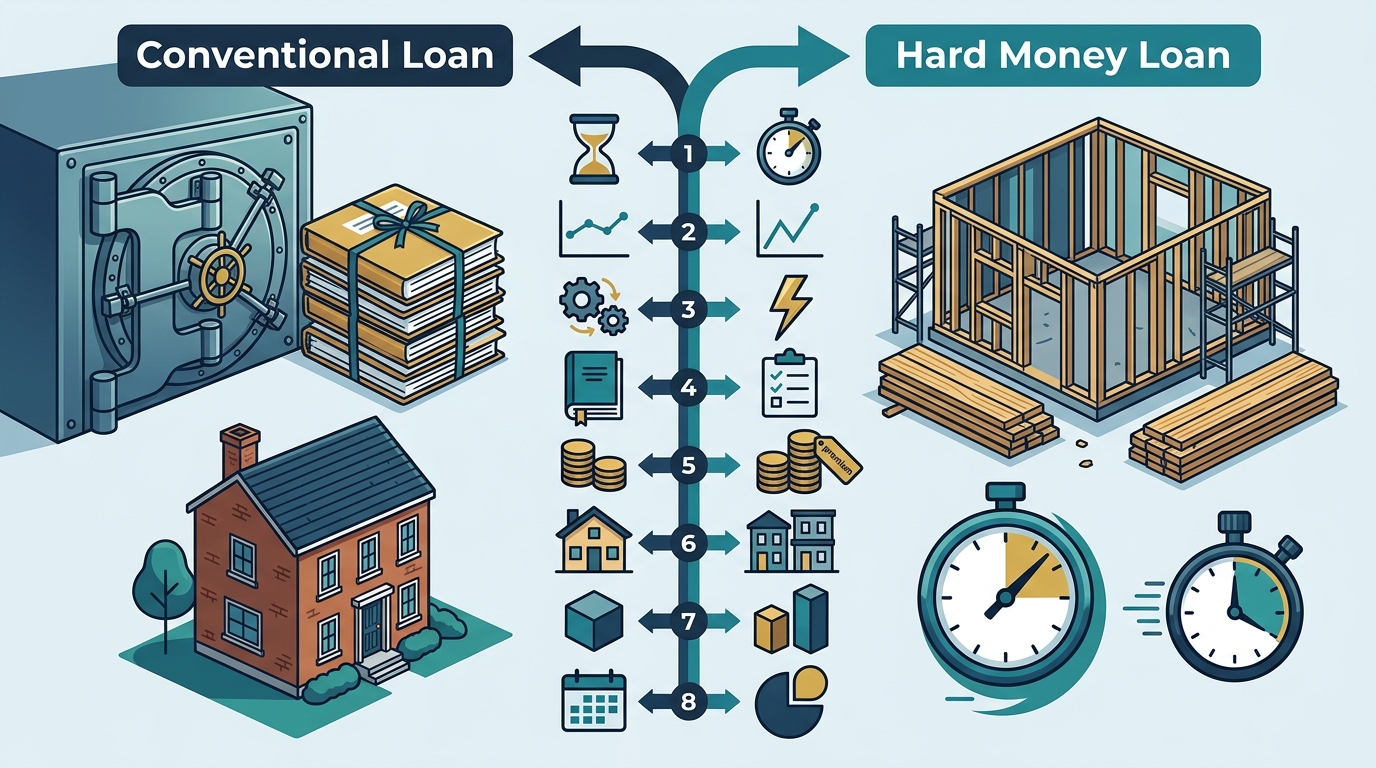
Factor 2 — Approval Speed and Funding Timeline
Speed is where hard money loans deliver their most compelling advantage. Hard money lenders can approve and fund loans in as few as 3 to 5 business days—sometimes faster for established borrowers. Conventional mortgage approvals, by contrast, routinely take 30 to 45 days or longer due to extensive documentation requirements, appraisals, and underwriting queues.
For auction purchases, competitive bidding situations, or distressed properties with motivated sellers, fast funding can be the difference between securing a deal and watching it go to a cash buyer.
Factor 3 — Qualification Requirements
Conventional lenders evaluate you through a detailed financial lens: credit score (typically 620 or higher, with the best rates reserved for 740+), verifiable income, employment history, and debt-to-income ratios. Self-employed borrowers or those with irregular income streams often face extra scrutiny.
Hard money lenders take a fundamentally different approach. Approval focuses on the value of the property and the investment potential, making it easier for borrowers with imperfect credit or limited documentation to qualify. Your credit score may influence the rate you receive, but it rarely determines whether you get approved at all.
Factor 4 — Loan Terms and Repayment Structure
Conventional mortgages offer 15- to 30-year repayment terms with fully amortizing monthly payments that blend principal and interest. This predictability makes them ideal for buy-and-hold investors who plan to own a property for years.
Hard money loans typically run 6 to 36 months and often feature interest-only monthly payments followed by a balloon payment at maturity. This structure keeps monthly obligations low during a renovation or repositioning phase, but it requires a clear plan for repaying the principal when the term expires.
Factor 5 — Loan-to-Value Ratios and Down Payments
Conventional mortgages can reach LTV ratios of 97% for owner-occupied purchases (with private mortgage insurance) and around 75–80% for investment properties. Hard money lenders are more conservative—most require LTV ratios between 65% and 75%, meaning you need a larger down payment or equity stake.
The trade-off is that hard money lenders evaluate the after-repair value (ARV) of the property in many fix-and-flip scenarios, which can effectively increase your borrowing power if the renovation adds significant value.
Factor 6 — Flexibility and Negotiation Room
Conventional loans follow standardized guidelines with limited room for customization. The terms, documentation requirements, and property condition standards are largely fixed by the institutional framework.
Hard money lenders offer significantly more flexibility. Terms are often tailored to the borrower's specific deal, and experienced investors can negotiate interest rates, repayment schedules, and fee structures. Building a track record with a particular lender can improve your leverage over time.
Factor 7 — Eligible Property Types and Conditions
Conventional lenders require properties to meet specific condition standards—an appraisal must confirm the home is safe, structurally sound, and habitable. Distressed properties that need extensive renovation typically cannot qualify for conventional financing.
Hard money lenders specialize in properties that fall outside conventional guidelines. Whether it is a gutted warehouse, a fire-damaged duplex, or a commercial building needing a complete overhaul, hard money financing can accommodate unconventional and distressed assets because the lending decision is based on the property's potential value after improvements.
Factor 8 — Exit Strategy Requirements
Conventional loans do not require an explicit exit strategy—you simply make monthly payments over the life of the loan. Hard money loans, however, demand a well-defined plan for repayment before the short term expires. Common exit strategies include:
- Sell the property after renovation for a profit (fix-and-flip).
- Refinance into a conventional or DSCR loan once the property is stabilized and qualifies for traditional financing.
- Pay off with proceeds from the sale of another asset.
Lenders evaluate your exit strategy during underwriting. A weak or unrealistic plan can result in denial or less favorable terms.
Side-by-Side Comparison Table
| Factor | Conventional Loan | Hard Money Loan |
|---|---|---|
| Interest Rates | ~6–7% (30-yr fixed) | 8–14% |
| Approval Time | 30–45 days | 3–7 days |
| Loan Term | 15–30 years | 6–36 months |
| LTV Ratio | Up to 80% (investment) | 65–75% |
| Credit Score Emphasis | High (620+ required) | Low (asset-focused) |
| Property Condition | Must meet standards | Distressed OK |
| Repayment Structure | Amortizing P&I | Interest-only + balloon |
| Best For | Long-term holds, primary residences | Flips, bridge deals, value-add projects |
Real-World Scenarios: Which Loan Wins?
Scenario A: Buy-and-Hold Rental Property
You find a turnkey duplex generating stable rental income and plan to hold it for 10+ years. A conventional loan wins here—lower rates, predictable payments, and a 30-year term align perfectly with a long-term cash-flow strategy.
Scenario B: Competitive Fix-and-Flip
A distressed single-family home hits the market at $185,000 with an ARV of $290,000. Multiple investors are circling. A hard money loan lets you close in under a week, complete renovations over four months, and sell before a conventional lender would have even finished processing your application. Even at a 12% rate, the speed-driven profit far outweighs the higher interest cost.
Scenario C: Bridge to Permanent Financing
You discover a commercial property that needs moderate updates to qualify for a bank loan. A hard money loan bridges the gap—fund the purchase, make improvements, then refinance into a lower-rate conventional or DSCR loan once the property meets traditional lending criteria. Many investors use this two-step approach to access deals that would otherwise be out of reach.
Key Takeaways
- Match the loan to the strategy. Conventional loans reward patience and strong credit; hard money loans reward speed and deal-finding ability.
- Calculate total cost, not just rate. A higher interest rate on a six-month loan can cost less than a lower rate on a 30-year mortgage when measured against the project's profit.
- Prepare your exit strategy first. Hard money lenders will evaluate your plan to repay—have one before you apply.
- Leverage hard money as a stepping stone. Many successful investors start with hard money for acquisition and renovation, then refinance into conventional terms for the long haul.
- Negotiate hard money terms. Unlike conventional loans, rates, points, and schedules are often negotiable, especially as you build a track record with a lender.
Frequently Asked Questions
What is the main difference between a conventional loan and a hard money loan?
A conventional loan is a long-term mortgage from a bank or credit union that relies heavily on your credit score, income, and financial history. A hard money loan is a short-term, asset-based loan from a private lender that focuses on the property's value rather than the borrower's personal finances.
Are hard money loan interest rates always higher than conventional rates?
Yes, hard money rates are higher on an annualized basis—typically 8% to 14% compared to roughly 6–7% for conventional loans. However, because hard money loans are held for much shorter periods (often 6–12 months), the total dollar amount of interest paid can be comparable or even lower than years of conventional interest payments.
Can I refinance a hard money loan into a conventional mortgage?
Yes. Many investors use hard money loans as short-term financing and then refinance with a traditional bank loan once the property is stabilized or the project is complete. This strategy combines the speed of hard money with the long-term affordability of conventional financing.
What credit score do I need for a hard money loan?
Hard money lenders focus more on the property value than the borrower's credit. While a higher credit score may help you secure a better rate, many hard money lenders will approve borrowers with scores well below the 620 minimum typically required for conventional mortgages.
What types of properties can I finance with a hard money loan?
Hard money loans can finance a wide range of properties including single-family homes, multifamily buildings, commercial real estate, and distressed properties needing significant renovation. Conventional loans are generally limited to properties that meet established condition and habitability standards.
How fast can I close on a hard money loan?
Hard money loans can close in as few as 3 to 7 business days, compared to 30 to 45 days or more for conventional mortgages. This speed makes hard money ideal for auction purchases, competitive markets, and time-sensitive investment opportunities.
Find the Right Financing for Your Next Property
At Lenders A, we help borrowers navigate both conventional and hard money loan options to find the best fit for every property scenario. Whether you need the stability of a 30-year mortgage or the agility of short-term private financing, our team connects you with competitive lenders and clear guidance. Contact us today to discuss your property goals and explore your loan options.