

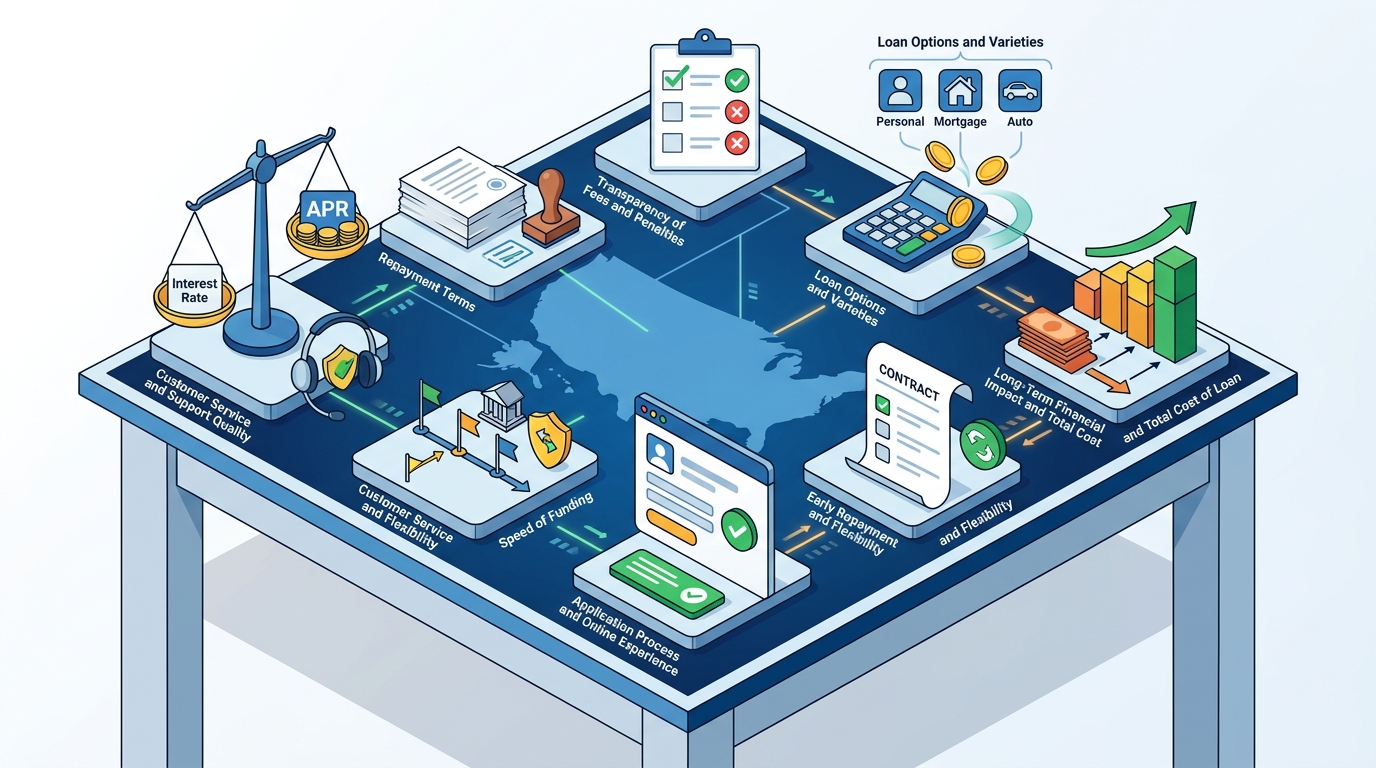
Picking the right loan provider can save you thousands of dollars and months of frustration. Whether you need a personal loan, a mortgage, or a short-term cash advance, the lender you choose affects your interest rate, repayment experience, and long-term financial health. Below are nine critical features every borrower in the United States should evaluate before signing on the dotted line.
1. Competitive Interest Rates and APR Transparency
The interest rate is the first number most borrowers look at, but the Annual Percentage Rate (APR) tells a fuller story. The APR bundles the interest rate together with origination fees and other charges into a single annualized figure, giving you a true cost-of-borrowing comparison across providers.
Be cautious of headline rates that seem unusually low. A promotional interest rate may only last for a short introductory period, after which your rate and monthly payment could jump significantly. Under federal law, any advertisement that quotes an interest rate must also display the APR, so always confirm that number before proceeding.
For context, the average APR on a 24-month personal loan in the United States is approximately 11.40 percent, according to Federal Reserve data. Rates you are offered will depend on your credit profile, income, and the lender's own pricing model, but that benchmark helps you gauge whether a quote is competitive.
2. Flexible Loan Amounts and Repayment Terms
Not every borrower needs the same amount of money or the same payback timeline. A quality loan provider lets you customize both the loan amount and the repayment period to match your budget. Look for lenders that offer a broad range — from a few hundred dollars up to $50,000 or more for personal loans — and multiple term lengths so you can balance monthly affordability against total interest paid.
When comparing lenders, pay attention to whether they offer both fixed-rate and variable-rate options. A fixed-rate APR locks in your interest rate for the life of the loan, keeping your monthly payment predictable and easier to budget around.
3. Clear Fee Structure
Fees can quietly erode the value of any loan. Common charges include origination fees (often 1 percent to nearly 10 percent of the loan amount), late-payment penalties, and administrative costs. Some lenders also charge application fees or annual maintenance fees.
A trustworthy provider will disclose every fee upfront — ideally before you formally apply. For mortgage borrowers, the lender is required to deliver a Loan Estimate within three business days of application. This document details estimated monthly payments and a full breakdown of fees and closing costs. Use it to compare providers on an apples-to-apples basis.
4. Funding Speed
When cash is needed urgently, the time between approval and deposit matters. Many online lenders now offer same-day or next-business-day funding for personal loans. To receive funds quickly, make sure every piece of information you submit is complete and accurate, because errors can delay the disbursement process.
For mortgage loans, turnaround varies more widely. Some digital-first lenders can close in as little as five days, while traditional banks may take several weeks. Ask prospective lenders about their average processing time over the past six months to set realistic expectations.
5. Credit-Score Flexibility
Your credit score heavily influences which lenders will work with you and what rates they offer. Most mainstream personal-loan providers prefer a FICO score of 670 or above, but a growing number of lenders cater to borrowers with fair or poor credit — scores of 580 and below — though higher interest rates or collateral requirements may apply.
Many lenders now offer prequalification tools that let you check estimated rates with only a soft credit pull, meaning there is no impact on your credit score. Take advantage of these to shop around before committing to a hard inquiry.
6. Responsive Customer Service
A lender's responsiveness can make or break your borrowing experience. Delayed callbacks, unclear explanations, and limited availability are among the most common borrower complaints. Look for providers that respond quickly, communicate clearly, and are willing to walk you through each step of the process.
Consider whether the lender offers multiple support channels — phone, email, live chat, and in-branch visits — and whether their hours align with your schedule. Some larger institutions provide round-the-clock support and the ability to upload documents through a mobile app, which can significantly speed things up.
7. Regulatory Compliance and Licensing
Any legitimate loan provider operating in the United States must comply with federal and state lending laws. The Truth in Lending Act (TILA) requires lenders to disclose fees, interest rates, and repayment terms before you sign any agreement. The Consumer Financial Protection Bureau (CFPB) oversees lending practices nationwide.
Before working with any lender, verify that they are licensed in your state. You can check for disciplinary actions through the National Multistate Licensing System (NMLS). Federally insured banks operate under an additional layer of regulatory supervision, and you can confirm a bank's status using the FDIC's BankFind tool.
8. Reputation and Customer Reviews
Online reviews provide a window into real borrower experiences. Look for detailed reviews that describe the application process, communication quality, and any surprises at closing — not just a generic star rating. Platforms like the Better Business Bureau, Google Reviews, Trustpilot, and the CFPB complaint database are all useful resources.
Personal referrals from friends, family, or your real estate agent also carry weight. Agents in particular tend to know which lenders close on time and which ones cause delays.
9. Prepayment Options Without Penalties
Paying off a loan early can save you a substantial amount in interest. However, some lenders charge prepayment penalties to recoup the interest income they would have earned. The best loan providers allow early payoff at no extra cost. Always confirm whether a prepayment penalty exists before you sign the loan agreement.
Key Takeaways
- Compare APR, not just the interest rate. The APR reflects the true annual cost of borrowing, including fees.
- Shop at least three to five providers. Getting multiple quotes — ideally on the same day — lets you make accurate side-by-side comparisons.
- Read the fine print on fees. Origination fees, late charges, and closing costs vary widely and can significantly change your total cost.
- Verify licensing and regulatory standing. Use the NMLS and FDIC databases to confirm a lender is legitimate and in good standing.
- Use prequalification tools. Soft-pull prequalification protects your credit score while letting you explore rates from multiple lenders.
- Prioritize transparency. A reputable lender discloses all terms and fees before you commit.
Frequently Asked Questions
What is the difference between an interest rate and an APR?
The interest rate is the base cost of borrowing expressed as a percentage. The APR adds origination fees and other charges to give you the total annualized cost. When comparing loan offers, the APR is the more accurate figure to use.
How many lenders should I compare before choosing one?
Experts recommend comparing at least three to five lenders. For mortgage shopping, try to collect all quotes within a 45-day window so multiple credit inquiries are treated as a single hard pull on your credit report.
Can I get a loan with bad credit in the USA?
Yes. Multiple lenders across the United States specialize in loans for borrowers with less-than-ideal credit scores. You may face higher interest rates or need to provide collateral, but options exist for a wide range of credit profiles.
What fees should I watch out for?
Common fees include origination fees (often 1–10 percent of the loan amount), late-payment penalties, application fees, and prepayment penalties. Always request a full fee disclosure before signing any agreement.
How fast can I get funded?
Many online personal-loan providers offer same-day or next-business-day funding. Mortgage loans take longer — anywhere from five days with digital-first lenders to several weeks with traditional banks.
How do I verify a lender is legitimate?
Check the lender's license through the National Multistate Licensing System (NMLS). For banks, use the FDIC's BankFind tool to confirm federal insurance status. You can also search the CFPB complaint database for any reported issues.
Choosing Wisely Starts with Asking the Right Questions
Selecting a loan provider is one of the most consequential financial decisions you will make. By evaluating these nine features — competitive rates, flexible terms, transparent fees, fast funding, credit-score flexibility, customer service, regulatory compliance, reputation, and prepayment freedom — you position yourself to find a lender that truly fits your needs. Take the time to compare, ask tough questions, and read every disclosure. Your future self will thank you.
At LendersA.com, we help borrowers across the United States navigate the lending landscape by providing clear, unbiased information so you can make confident decisions about your next loan.