

How to Choose Between Loan Providers: A Smart Borrower's Guide
Choosing the right loan provider can save you tens of thousands of dollars over the life of your mortgage. With banks, credit unions, private investors, and hard money lenders all competing for your business, the sheer number of options can feel overwhelming. The good news is that a structured comparison process turns confusion into clarity. This guide walks you through every step of evaluating loan providers so you can lock in the best rate, lowest fees, and fastest closing timeline for your specific property and financial situation.
Why Comparing Loan Providers Matters
Even a small difference in interest rate translates into major long-term savings. According to Bankrate, the difference between a 5.75% and 6.75% rate on a $350,000 loan saves roughly $200 per month and over $80,000 across a 30-year term. The Consumer Financial Protection Bureau (CFPB) estimates that homebuyers can save $600 to $1,200 per year simply by getting offers from multiple lenders.
Shopping around is not just smart; it is essential. Yet many borrowers walk into a single bank and accept whatever terms they are offered, leaving money on the table.
Know the Types of Lenders
A loan provider is any institution or individual that extends credit to a borrower under agreed-upon terms. Understanding each category helps you target the right fit.
Banks and Credit Unions
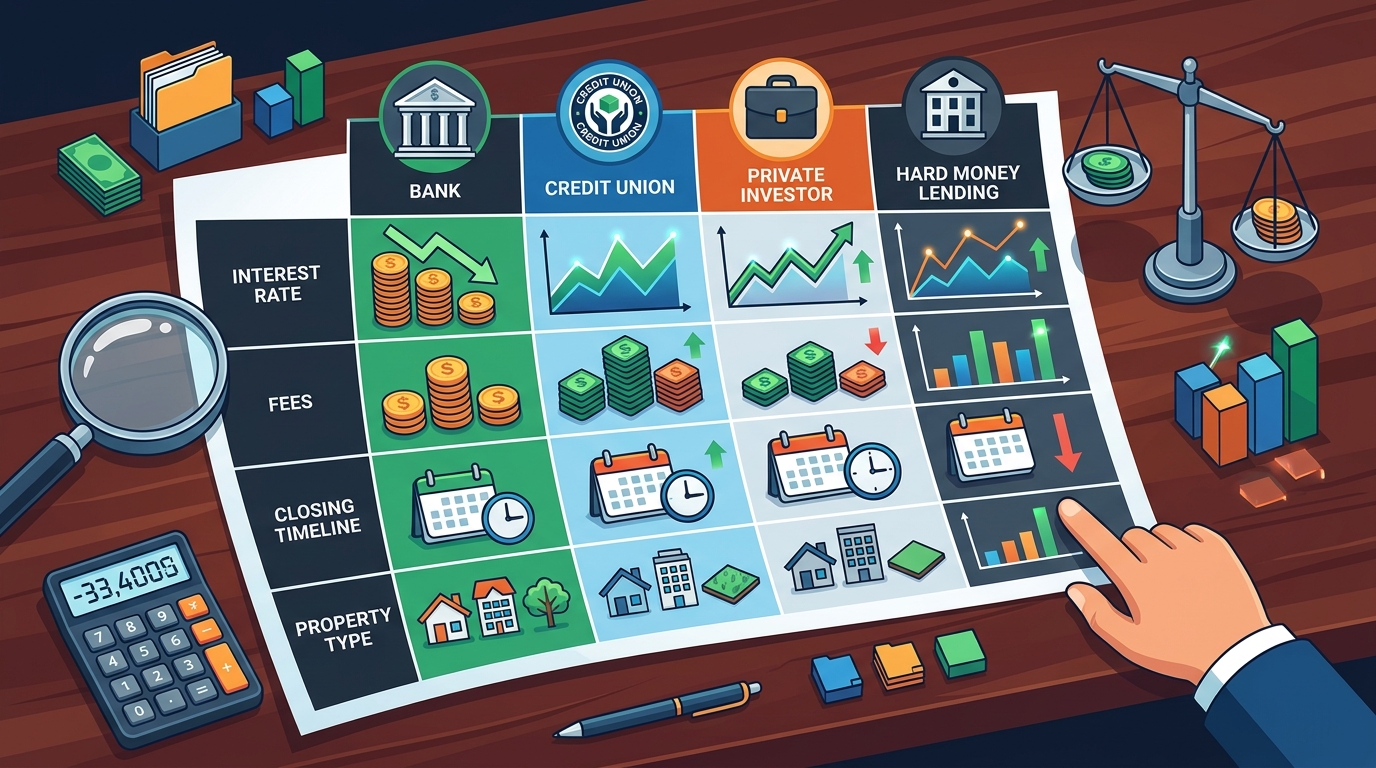
Traditional banks offer conventional, FHA, VA, and USDA mortgage products. Credit unions are member-owned nonprofits that often charge fewer fees and provide competitive rates. Both typically require strong credit and income documentation, and closings may take 30 to 45 days.
Hard Money and Private Lenders
A hard money loan is a short-term loan secured primarily by the equity in real estate, not the borrower's creditworthiness. These lenders can fund deals in days rather than weeks, which is critical for investors at auction. Learn how to choose a hard money lender on the Lendersa blog for a deeper dive.
Online Marketplaces
An online loan marketplace is a platform that aggregates offers from multiple lenders so borrowers can compare rates, fees, and terms in one place. Platforms like Lendersa use AI to match your scenario with hundreds of lenders across conventional and hard money programs for residential, commercial, and vacant land properties.
| Factor | Bank / Credit Union | Hard Money Lender | AI Marketplace (e.g., Lendersa) |
|---|---|---|---|
| Typical Rate Range | 6% – 8% | 9% – 14% | Varies (aggregates both) |
| Closing Speed | 30 – 45 days | 3 – 10 days | Depends on matched lender |
| Credit Requirements | Good to Excellent | Flexible / Equity-based | All profiles welcome |
| Best For | Primary residences, long-term holds | Fix-and-flip, bridge financing | Side-by-side comparison of all options |
Key Factors to Compare Across Providers
Interest Rate vs. APR
The Annual Percentage Rate (APR) is the total yearly cost of a loan expressed as a percentage, including both the interest rate and lender fees. The FTC advises that knowing the APR makes it easier to compare offers on an apples-to-apples basis. Always request the APR, not just the advertised interest rate.
Fees and Closing Costs
Origination fees can range from 1% to 10% of the loan amount. The CFPB recommends focusing on fees that vary by lender, including origination charges, required services, and lender credits. Use the Lendersa Advanced Calculator to model how different fee structures affect your total cost.
Closing Timeline and Flexibility
If you are bidding at auction or racing to close an investment deal, speed may outweigh rate. A marketplace that evaluates both loan optimization factors and closing speed can surface the right trade-off automatically.
Step-by-Step Comparison Process
Step 1: Define your goals. Are you buying a primary residence, refinancing, or flipping an investment property? Your goal dictates the loan type.
Step 2: Check your credit and finances. Review your credit reports at AnnualCreditReport.com and calculate your debt-to-income (DTI) ratio. Most lenders prefer a DTI under 36%, though some accept up to 50%.
Step 3: Get at least three offers. The CFPB recommends requesting Loan Estimates from a minimum of three lenders. Within a 45-day window, multiple mortgage credit inquiries count as a single hit on your credit report.
Step 4: Use an AI-powered marketplace. Rather than calling lenders individually, enter your scenario into the Lendersa LoanScore tool to instantly see how many programs match your profile and get competing offers.
Step 5: Negotiate. Your best bargaining chip is having competing Loan Estimates in hand. Lenders are often willing to match or beat rival offers.
Tools That Simplify Lender Comparison
Technology has reshaped how borrowers shop for loans. Lendersa aggregates thousands of loan programs from big banks, credit unions, private investors, and hard money brokers. Its AI evaluates over 20 underwriting factors, including income type, credit events, liquid reserves, and property condition, to surface the most competitive programs in seconds.
The platform's LoanImprove engine goes further by showing you exactly how small changes, like reducing your loan amount by 1% or improving your credit score by 25 points, could unlock better rates or higher approval odds. No SSN is required to start exploring, which removes a major friction point for early-stage shoppers.
For borrowers evaluating hard money options specifically, the commercial hard money lender directory provides a curated starting point alongside AI-matched results.
Red Flags to Watch For
Not every lender operates transparently. Watch for these warning signs:
- Upfront fees before issuing a Loan Estimate. Except for a credit report fee, charging you before providing a Loan Estimate is against federal law.
- Pressure to sign blank forms. Never sign documents with blank fields to be completed later.
- Bait-and-switch terms. If the Loan Estimate differs significantly from what the loan officer discussed, ask questions or consider another lender.
- Lack of licensing. Verify any lender through the NMLS Consumer Access database. Lendersa, for example, operates under CA NMLS 1795154.
Read how mortgage brokers can rip you off for a detailed look at hidden tactics and how to protect yourself.
Key Takeaways
- Always compare at least three loan offers before committing. Even small rate differences add up to thousands over the loan's life.
- Compare APR, not just interest rate, to capture the true cost of borrowing.
- Hard money loans trade higher rates for speed and flexible credit requirements, making them ideal for investors.
- AI-powered marketplaces like Lendersa compare thousands of programs across 20+ factors in seconds, removing manual guesswork.
- Within a 45-day window, multiple mortgage credit inquiries count as one, so shopping around will not damage your score.
- Use competing Loan Estimates as leverage to negotiate better terms with your preferred lender.
- Verify every lender's license through NMLS before sharing personal financial information.
Frequently Asked Questions
How many loan providers should I compare?
The CFPB recommends getting offers from at least three lenders. Using a marketplace like Lendersa lets you compare hundreds of programs at once, making the process much faster.
Will shopping around for loans hurt my credit score?
No. Credit bureaus treat multiple mortgage inquiries within a 45-day window as a single inquiry, so your score is protected while you compare.
What is the difference between interest rate and APR?
The interest rate is the cost of borrowing the principal. The APR includes the interest rate plus lender fees like origination charges, giving you the total annual cost of the loan.
When should I choose a hard money lender over a bank?
Hard money lenders are best when you need to close quickly, have non-traditional income, or cannot meet bank credit requirements. They focus on property equity rather than borrower credit history.
What is LoanScore on Lendersa?
LoanScore is Lendersa's proprietary metric that ranges from 0 to 99. It measures the likelihood that your loan request will receive competitive offers from participating lenders based on your specific financial profile and property details.
Can I get loan offers without providing my Social Security Number?
Yes. Lendersa allows you to view hard money and bank loan options instantly without requiring an SSN to start. This lets you explore options before formally applying.
What factors matter most for loan approval?
Income, credit score, and loan-to-value (LTV) ratio are the most critical factors. However, Lendersa's calculator evaluates 15 or more additional factors, including reserves, income verification type, and property condition, that also influence your rate and terms.
How do I spot a predatory lender?
Red flags include upfront fees before a Loan Estimate, pressure to sign blank forms, rates far above market average, and an unlicensed NMLS status. Always verify credentials and read the fine print.
Start Comparing Loan Providers Today
Stop guessing and start comparing. Use the Lendersa Advanced Calculator to enter your loan scenario and instantly see matched programs from hundreds of lenders. No SSN required, no obligation, and no credit impact. Let lenders compete for your deal so you walk away with the best possible terms.