

Choosing the wrong hard money lender can cost you thousands in hidden fees, delay your closing, or even kill a deal entirely. With private lending volume growing 14% year over year in 2024, more lenders than ever are competing for investor business. That sounds like good news, but it also means borrowers must sharpen their evaluation skills. This guide walks you through the exact criteria, comparison points, and red flags you need to assess before signing with any hard money lender, so every dollar you borrow works harder for your project.
What Is a Hard Money Loan?
A hard money loan is a short-term, asset-backed loan provided by private investors or companies rather than traditional banks. Unlike conventional mortgages with 15- to 30-year terms, hard money loans typically range from one to three years and carry higher interest rates in exchange for faster funding and more flexible qualification criteria.
Hard money lenders focus primarily on the value of the property being purchased rather than the borrower's credit score. While your financial history still matters, the collateral, meaning the property itself, plays the most significant role in securing the loan. This asset-first approach is what makes hard money attractive for fix-and-flip investors, bridge financing, and commercial real estate projects.
Key Criteria for Evaluating Hard Money Lenders
Not every hard money lender is right for every deal. Here are the factors that matter most when evaluating your options.
Loan-to-Value (LTV) and After-Repair Value (ARV)
LTV is the ratio of the loan amount to the property's current value. Most hard money lenders cap LTV between 60% and 75%. For renovation projects, lenders also evaluate the after-repair value (ARV). ARV is the estimated market value of a property after planned improvements are completed. A lower after-repair LTV generally unlocks better terms and more lender flexibility.
Down Payment and Equity Requirements
Borrowers typically need to put down 20% to 35% of the property's value. On average, lenders want 30% to 40% equity to move forward. Having adequate skin in the game reduces lender risk and often results in more competitive rates.
Credit and Experience Expectations
While credit scores are less central than in traditional lending, some lenders set minimums around 660 or higher. Experienced investors with a history of successful projects often receive faster approvals and better rates. First-time borrowers should expect slightly stricter terms or higher interest rates.
How to Compare Loan Terms Side by Side
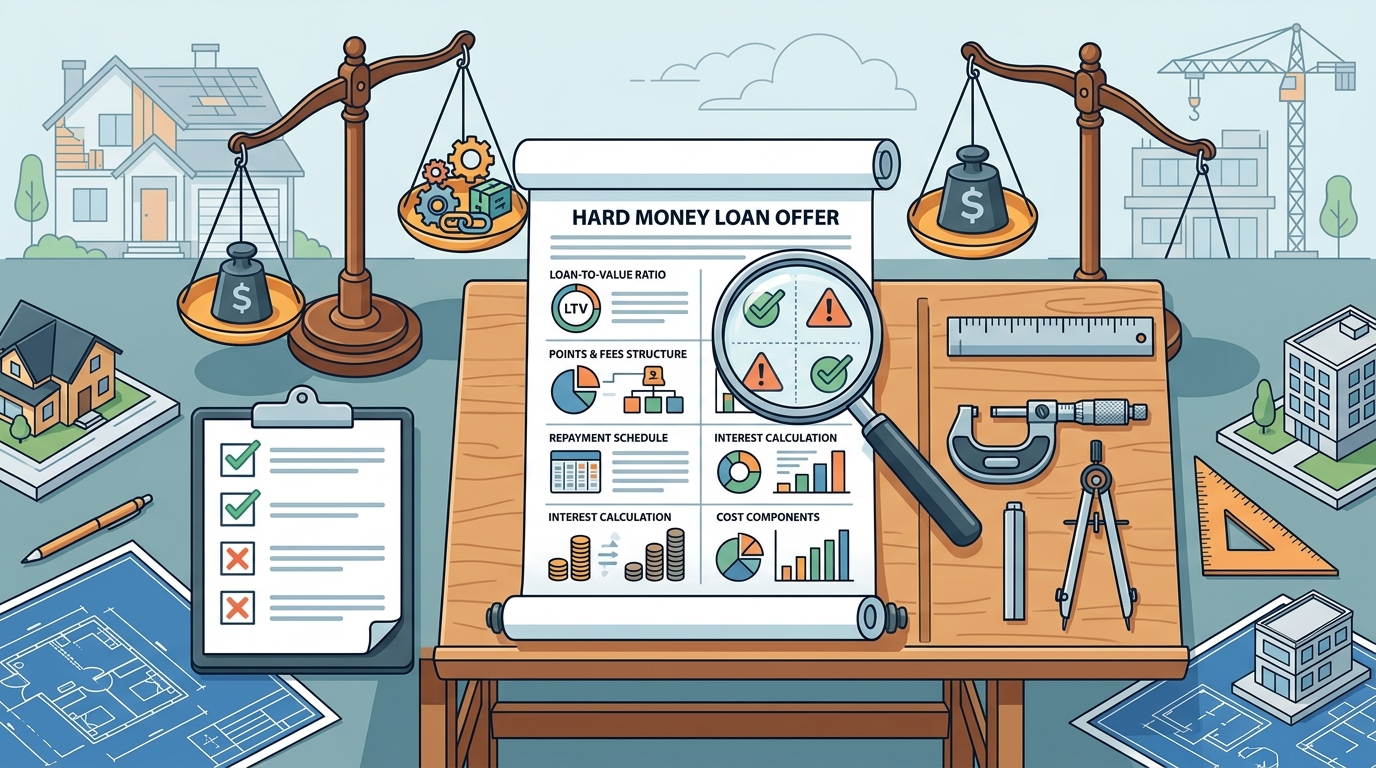
Rates alone do not tell the full story. When comparing offers, look at the total cost of borrowing, including origination fees (points), interest rate, loan term, prepayment penalties, and draw schedules for rehab funds.
| Evaluation Factor | What to Look For | Typical Range |
|---|---|---|
| Interest Rate | Fixed vs. variable; monthly cost | 9%–14% |
| Origination Fee (Points) | Upfront cost as % of loan | 1–3 points |
| Loan Term | Repayment window | 6–24 months |
| LTV Cap | Max loan relative to property value | 60%–75% |
| Down Payment | Cash required at closing | 20%–35% |
| Closing Speed | Days from application to funding | 5–21 days |
| Prepayment Penalty | Cost of early payoff | None to 3 months interest |
Using a platform like the Lendersa LoanScore tool lets you see how your specific scenario stacks up across hundreds of lenders before you even submit a formal application, all without providing your Social Security Number.
Assessing a Lender's Track Record and Reputation
A lender's track record is one of the strongest predictors of a smooth transaction. Look for verifiable data: how many loans they have funded, their default rate, and how long they have been in business. Check state licensing through the NMLS Consumer Access database to verify credentials.
Online reviews on Google, the Better Business Bureau, and real estate investor forums provide candid borrower experiences. A lender who offers personalized support throughout your loan term is more likely to help you navigate unexpected challenges during your project. You can also browse the Lendersa hard money lenders directory, which includes over 4,500 lenders across all 50 states and lets you search by proximity to your property.
Speed, Flexibility, and Closing Timelines
In competitive real estate markets, speed matters. Hard money lenders often make decisions themselves rather than relying on a team of underwriters, allowing faster credit decisions. Many can fund within 5 to 14 days, compared to 30 to 45 days for conventional loans.
Flexibility is equally important. Does the lender finance your specific property type, whether residential, commercial, or vacant land? Do they offer rehab draws tied to construction milestones? Understanding the draw process is crucial for maintaining your project's timeline and budget.
If you need to compare fast-closing options against conventional alternatives, the Lendersa loan request tool lets you submit a single scenario and receive multiple competing offers from both hard money lenders and banks simultaneously.
Red Flags to Watch For
Not every lender operates in your best interest. Be cautious of these warning signs:
- No state licensing or NMLS registration. Legitimate lenders are registered. Verify before proceeding.
- Vague fee structures. If a lender cannot clearly explain all costs upfront, walk away.
- Pressure to skip due diligence. A trustworthy lender encourages appraisals, inspections, and legal review.
- No exit strategy discussion. A solid exit strategy is a fundamental part of hard money lending. If the lender does not ask about yours, they may not have your long-term success in mind.
- Unrealistically low rates. If the rate seems too good to be true compared to market norms, hidden fees likely exist elsewhere in the deal.
Key Takeaways
- Hard money lenders prioritize property value and collateral over borrower credit scores, but experience and financial discipline still matter.
- Always compare the total cost of borrowing, not just the interest rate. Include origination fees, term length, and prepayment penalties.
- Most lenders require 20% to 35% down and cap LTV at 60% to 75% of property value.
- A clear exit strategy, whether selling, refinancing, or using rental income, is essential for approval and favorable terms.
- Verify licensing through NMLS and check reviews on independent platforms before committing.
- Use marketplace tools like Lendersa to get multiple competing offers from one loan request without sharing your SSN upfront.
- Watch for red flags such as vague fees, missing credentials, and pressure to skip inspections.
Frequently Asked Questions
What is the most important factor hard money lenders evaluate?
The property itself is the most important factor. Lenders assess the current value, location, condition, and after-repair value (ARV) of the collateral. A strong property in a desirable market with solid resale potential will receive better terms than a weaker asset, regardless of the borrower's credit profile.
How fast can a hard money loan close?
Many hard money lenders can fund a loan in 5 to 14 business days. Some close even faster for experienced borrowers with complete documentation. By comparison, conventional bank loans often take 30 to 45 days.
Do I need a high credit score for a hard money loan?
Credit scores are less critical than with traditional lending, but they still play a role. Some lenders set a minimum around 660, while others are more flexible. A lower credit score may result in a higher interest rate or a requirement for additional collateral.
What is a typical LTV for a hard money loan?
Most hard money lenders cap LTV between 60% and 75% of the property's current appraised value. For fix-and-flip projects, lenders may also consider 65% to 70% of the after-repair value when calculating loan limits.
Why is an exit strategy important for hard money lending?
An exit strategy is a borrower's plan for repaying the loan before its maturity date. Common strategies include selling the renovated property, refinancing into a conventional mortgage, or leveraging rental income. Lenders require a clear plan because hard money loans are short-term, typically 6 to 24 months, and the lender needs confidence that repayment is feasible.
Can I compare multiple hard money lenders at once?
Yes. Loan marketplaces like Lendersa allow you to enter a single loan scenario and receive competing offers from hundreds of hard money lenders and private investors. This creates a competitive environment that drives lenders to offer their best terms to win your business.
What fees should I expect beyond the interest rate?
Common fees include origination points (1 to 3 points of the loan amount), appraisal fees, title and escrow charges, and potential prepayment penalties. Always request a full fee breakdown before signing any loan documents.
Should I choose a local or national hard money lender?
Local private investors who are familiar with your market area can often approve loans faster and may offer higher LTV or better rates. However, national lenders may have more capital and a wider range of programs. Using the Lendersa lender search tool, you can find lenders sorted by their distance from your property to evaluate both local and national options.
Ready to Find the Right Hard Money Lender?
Stop calling lenders one by one. Start a free loan request on Lendersa and let hundreds of hard money lenders and banks compete for your deal. No SSN required to begin, and you will see competing offers in minutes.