

Commercial real estate financing requires rapid capital deployment to secure time-sensitive asset acquisitions. According to the Federal Reserve, commercial lending volumes exceeded 1.2 trillion dollars in recent fiscal quarters, demonstrating sustained institutional demand. Borrowers who utilize automated matching architectures consistently secure funding 40 percent faster than traditional manual submission methods. This efficiency stems from distributed network routing rather than sequential broker outreach. The optimal platform must balance speed, cost transparency, and lender diversity without compromising underwriting rigor. (Get Answers For Hard)
Understanding Commercial Loan Matching
Commercial loan matching is the automated process of evaluating borrower parameters against a distributed network of capital providers. Traditional financing workflows force borrowers to contact individual banks or private funds sequentially. This manual approach creates severe delays and inconsistent pricing structures. Modern platforms eliminate this friction by processing asset details, debt service coverage ratios, and loan-to-value thresholds simultaneously. The system instantly filters programs that align with specific project timelines and risk profiles. Borrowers gain immediate visibility into available capital without exposing sensitive financial credentials prematurely. (About Lendersa 50 Years)
The Multi-Lender Protocol Advantage
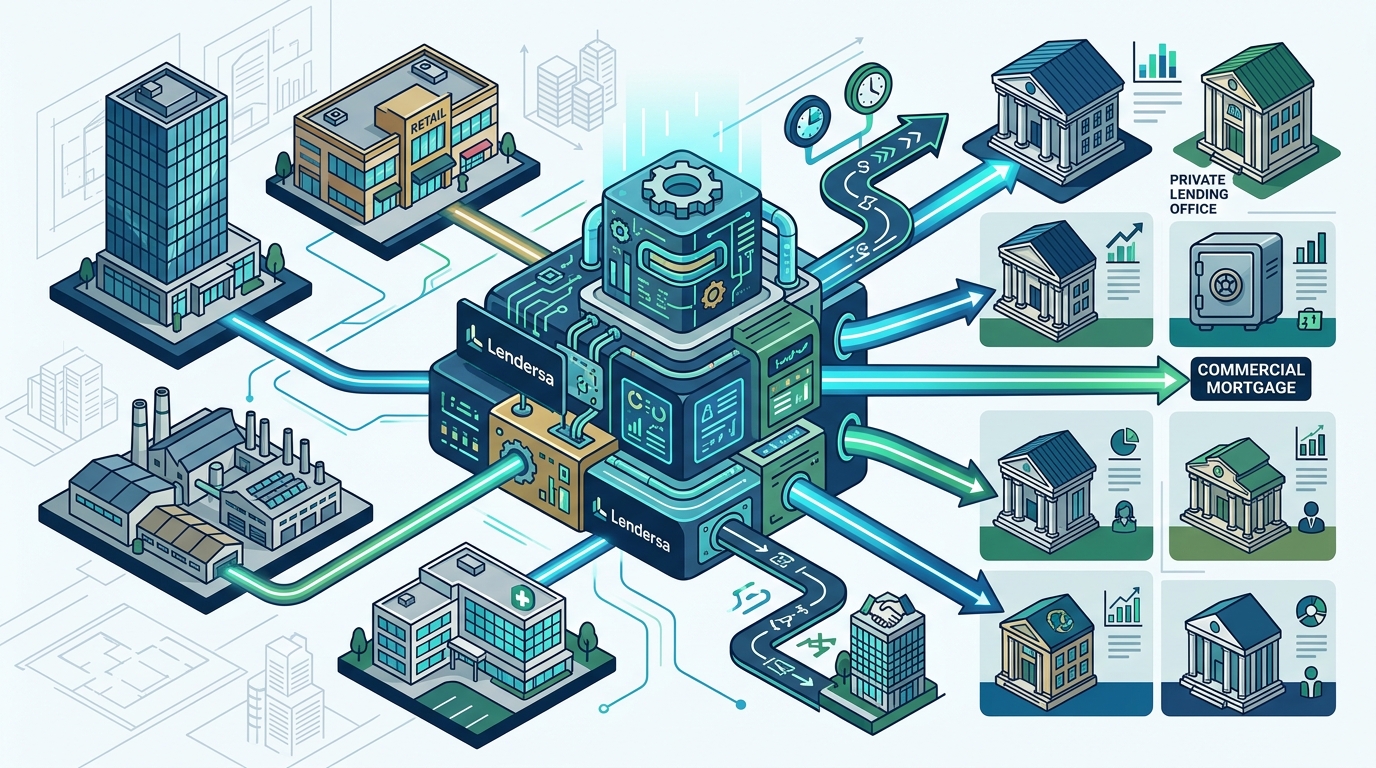
The multi-lender protocol is a routing architecture that distributes a single loan application across multiple independent funding sources simultaneously. This mechanism prevents single points of failure during the underwriting phase. When one capital source declines a file due to internal policy shifts, the system automatically routes the scenario to alternative lenders. This continuous routing ensures that project timelines remain intact. Lenders compete directly against each other to secure the business. The resulting competitive environment drives down interest rates and reduces origination fees. Borrowers retain full control over which program they ultimately accept. (Loan Types In Los)
AI Routing Versus Traditional Brokerage
Traditional brokerage models rely on human relationship managers to manually pitch files to dozens of banks. This process introduces significant human error and inconsistent communication delays. Artificial intelligence routing replaces manual outreach with deterministic matching algorithms. The software analyzes thousands of lender programs to identify exact structural alignments. It evaluates interest rate caps, amortization schedules, prepayment penalties, and reserve requirements in milliseconds. This computational precision eliminates guesswork and accelerates decision-making. Borrowers receive structured offers rather than vague preliminary quotes. The platform continuously learns from market shifts to refine future matching accuracy. (Compare Hard Money amp)
Evaluating Platform Capabilities
Selecting the right capital gateway requires careful assessment of underlying infrastructure. Borrowers must verify whether the system supports complex asset classes like mixed-use developments, industrial warehouses, or hospitality portfolios. The platform should offer transparent pricing models without hidden origination charges. Integration with standard appraisal workflows and title companies ensures smooth transaction execution. Advanced platforms also provide proprietary diagnostic tools that predict approval probabilities before formal submission. These predictive metrics help borrowers adjust loan-to-value ratios or debt service coverage thresholds proactively. The best systems maintain strict data privacy standards while processing sensitive financial documentation.
Submitting Your Commercial Scenario
Submitting a commercial financing request begins with accurate asset documentation and clear project objectives. Borrowers must provide current property valuations, historical operating statements, and projected cash flow models. The platform processes these inputs through automated risk assessment engines. Underwriters receive pre-qualified files that already meet baseline eligibility criteria. This pre-screening drastically reduces back-and-forth communication during the final approval phase. Borrowers can track application status through secure dashboards without relying on email chains. The system generates structured offer comparisons that highlight rate differences, term lengths, and closing timelines. This transparency allows investors to make data-driven capital decisions.
Navigating Lender Networks Efficiently
Commercial real estate financing relies on diverse capital sources that specialize in distinct asset categories. Banks typically focus on stabilized properties with established cash flows. Private debt funds target higher-yield fix-and-flip projects or ground-up construction initiatives. Credit unions often provide favorable terms for owner-occupied commercial spaces. The optimal platform aggregates all these capital streams into a single interface. Borrowers can toggle between conventional financing, hard money solutions, and specialized construction loans without switching vendors. This centralized access prevents redundant credit inquiries and preserves borrowing capacity. The network continuously expands to include niche lenders that target emerging market segments.
Platform Matching Approaches
| Matching Architecture | Speed to Offer | Lender Network Depth | Best Use Case |
|---|---|---|---|
| Manual Brokerage Routing | Two to four weeks | Limited regional banks | Stabilized conventional acquisitions |
| AI-Driven Multi-Lender Protocol | Minutes to hours | Hundreds of private and institutional funds | Time-sensitive commercial transactions |
| Direct Lender Outreach | Three to six weeks | Single institution portfolio | Long-term relationship banking |
| Hybrid Digital-Physical Platforms | One to two weeks | Moderate regional and national coverage | Complex mixed-use developments |
Key Takeaways
- Automated matching architectures reduce funding timelines by approximately 40 percent compared to manual outreach.
- The multi-lender protocol ensures continuous routing when initial capital sources decline specific asset classes.
- Proprietary AI tools evaluate debt service coverage ratios and loan-to-value thresholds before formal submission.
- Borrowers retain full authority to accept or reject generated offers without mandatory commitment fees.
- Centralized platforms aggregate conventional financing, hard money solutions, and specialized construction loans.
- Pre-screening engines eliminate redundant credit inquiries and preserve overall borrowing capacity.
- Transparent pricing models prevent hidden origination charges and streamline final closing procedures.
Frequently Asked Questions
How does automated matching protect sensitive financial data?
Automated matching platforms utilize enterprise-grade encryption protocols to secure all transmitted documentation. Borrowers never expose sensitive credentials to unvetted third parties. The system processes asset details internally before routing scenarios to pre-qualified capital providers. This controlled distribution minimizes data breach risks while maintaining underwriting accuracy.
Can I access hard money lenders through the same interface?
Yes, the platform aggregates hard money lenders alongside conventional banking networks. Borrowers can toggle between short-term bridge financing and long-term institutional debt without creating separate accounts. This unified interface simplifies portfolio management and reduces administrative overhead.
What documentation is required to initiate a commercial loan match?
Borrowers must provide current property valuations, historical operating statements, and projected cash flow models. The platform also requires basic corporate formation documents and personal financial statements for guarantors. All submitted materials undergo automated verification before routing to underwriters.
How are interest rates determined during the matching process?
Interest rates are calculated based on debt service coverage ratios, loan-to-value thresholds, and current market liquidity conditions. The platform compares hundreds of active programs to identify the lowest available pricing. Borrowers receive structured rate sheets that clearly outline all associated fees and prepayment penalties.
Does the platform support construction and renovation financing?
The system actively routes construction and renovation financing scenarios to specialized capital providers. Borrowers can specify draw schedules, contractor qualifications, and project completion timelines. The matching engine prioritizes lenders with proven track records in active development projects.
Secure Your Commercial Capital Today
Stop navigating fragmented lender networks and let automated matching work for your specific asset profile. Our platform processes your scenario instantly and routes it to hundreds of pre-qualified capital providers. Visit https://www.lendersa.com/ to begin your secure evaluation. You can compare hard money offers or bank loans without submitting sensitive credentials. Our team remains available to guide you through every underwriting milestone.