

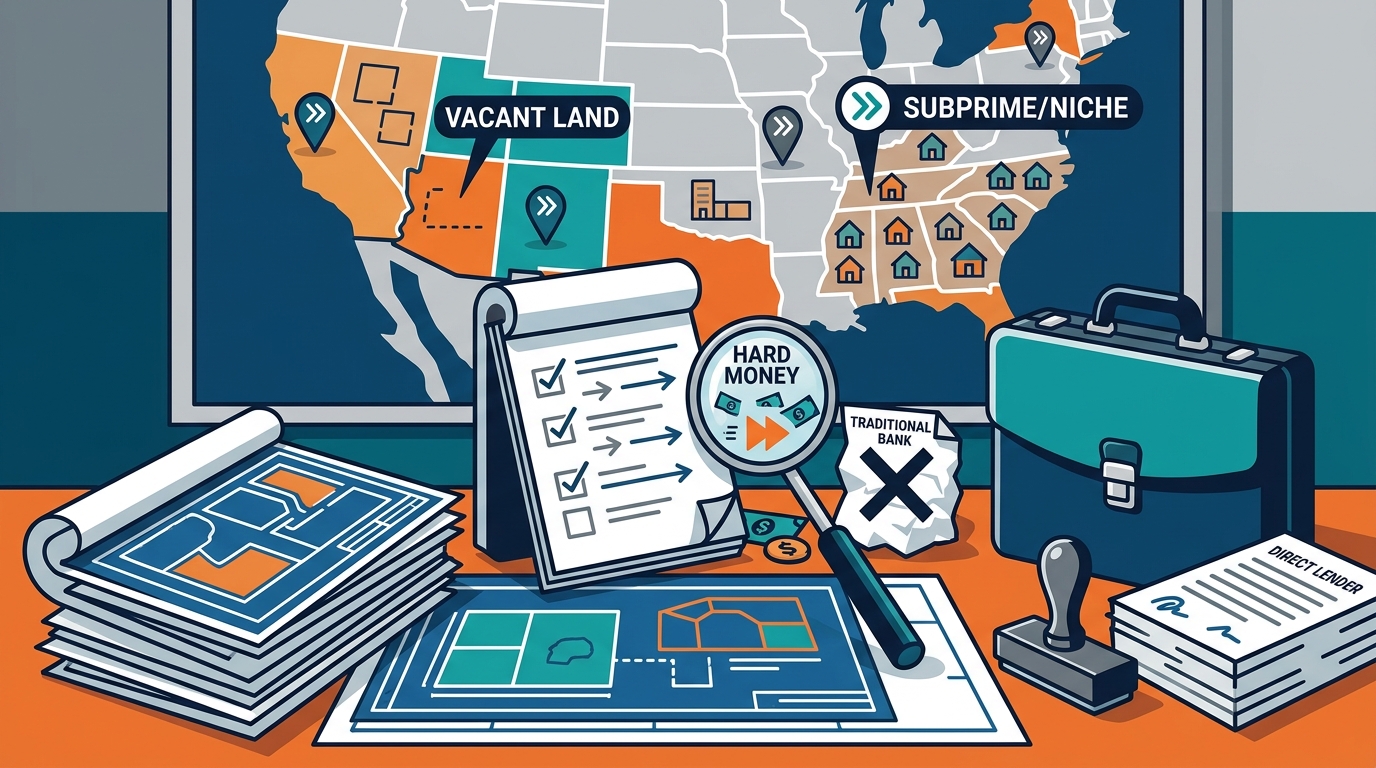
Securing capital for vacant land or subprime residential properties is notoriously difficult in traditional banking channels. According to industry data, conventional lenders reject over 30% of loan applications due to credit or collateral issues, leaving investors to seek alternative funding sources. This guide explains how to identify direct hard money lenders who specialize in these niche asset classes and how to leverage competitive bidding to secure the best terms. (Get Answers For Hard)
Understanding Hard Money Lending
Hard money lending is a specialized form of asset-based lending where the loan is secured by real estate collateral. Unlike conventional mortgages, which heavily weigh the borrower's credit score and debt-to-income ratio, hard money lenders focus primarily on the After Repair Value (ARV) or the current equity of the property. This makes it an ideal solution for borrowers who need speed and flexibility but may not meet strict bank criteria. (About Lendersa 50 Years)
Hard money is defined as a short-term, high-interest loan provided by private investors or companies, secured by real property. These loans are typically used for fix-and-flip projects, bridge financing, or land acquisition where traditional financing is unavailable. The speed of funding is a critical advantage, with closings often occurring in days rather than weeks. (Loan Types In Los)
For investors, the trade-off is clear. You pay higher interest rates and points to the lender in exchange for rapid access to capital and the ability to close on time. This is particularly valuable in competitive markets where auction deadlines are strict. Federal Housing Finance Agency data indicates that housing market velocity is heavily dependent on the availability of quick capital for investors. (Compare Hard Money amp)
Vacant Land Loan Strategies
Finding direct hard money lenders for vacant land requires a specific approach. Land loans are considered higher risk because the property generates no income and is harder to liquidate if the borrower defaults. Consequently, lenders require higher down payments and stricter loan-to-value (LTV) ratios. (Compare Hard Money amp)
When seeking vacant land financing, you must present a clear development plan. Lenders want to see how the land will be improved and what the exit strategy is. Whether you are looking for raw land or a lot with utilities, the key is to demonstrate equity and a viable path to value creation.
Lendersa® aggregates programs from lenders who specifically handle vacant land, commercial, and residential properties. By using our platform, you can access a network that includes private investors and hard money brokers who specialize in non-standard collateral. Investopedia reports that hard money lenders often offer up to 65-70% LTV for raw land, compared to 80-90% for improved residential properties.
Types of Vacant Land Loans
- Raw Land Loans: For undeveloped property with no utilities. Highest risk, lowest LTV.
- Lot Loans: For lots with existing utilities and road access. Lower risk, higher LTV.
- Bridge Loans: Short-term financing to secure land while arranging long-term construction capital.
Subprime Residential Options
Subprime residential loans are designed for borrowers with lower credit scores or complex financial histories. These loans are often referred to as Non-QM (Non-Qualified Mortgage) loans. They do not meet the federal government's guidelines for qualified mortgages but are offered by private lenders who are willing to take on more risk for higher returns.
Subprime lending is defined as the practice of lending to borrowers who do not qualify for conventional mortgage rates due to poor credit history or high debt levels. These loans often feature adjustable rates or higher fixed rates to compensate for the increased risk of default.
If you have bad credit or no income documentation, hard money lenders may still fund your project. They focus on the property's value and your equity injection rather than your W-2 income. This is crucial for real estate investors who may have irregular income streams from multiple properties.
Lendersa® connects you with lenders who offer Consumer Financial Protection Bureau guidelines compliant Non-QM products. These include bank statement loans, asset-based loans, and interest-only options. The platform allows you to compare these offers instantly without impacting your credit score during the initial search phase.
Benefits of Subprime Hard Money
- No Income Verification: Many lenders accept bank statements or asset reserves instead of tax returns.
- Credit Flexibility: Lenders may overlook past bankruptcies or foreclosures if equity is sufficient.
- Fast Closing: Decisions are often made within 24-48 hours.
The Multi-Lender Protocol Advantage
Manually contacting dozens of hard money lenders is inefficient and time-consuming. The Multi-Lender Protocol used by Lendersa® automates this process. Our AI searches thousands of lender programs to match your specific scenario with the most suitable capital sources.
Instead of submitting your information to one lender at a time, you submit it once. Our system then routes your request to multiple qualified lenders simultaneously. This creates a competitive environment where lenders bid for your business, driving down rates and improving terms.
This approach is particularly effective for complex loans like vacant land or subprime residential. Lenders who specialize in these niches are more likely to respond with tailored offers. National Association of Realtors data shows that investors who use multiple capital sources close deals 40% faster than those relying on a single lender.
How the Protocol Works
- Search: AI matches your property type and loan purpose with hundreds of lenders.
- Compare: Top matching programs are evaluated for rate, cost, and speed.
- Negotiate: Lenders compete to offer the best terms for your specific deal.
- Finalize: The top lender is awarded the loan, with runners-up on standby.
Loan Type Comparison
Understanding the differences between loan types is essential for selecting the right lender. The table below summarizes the key characteristics of hard money, conventional, and private loans for vacant land and subprime scenarios.
| Loan Type | Best For | Credit Requirement | Closing Time | LTV Ratio |
|---|---|---|---|---|
| Hard Money | Fix & Flip, Vacant Land | Flexible / Asset-Based | Days | 65-75% |
| Conventional | Primary Residence, Investment | Good to Excellent | 30-45 Days | Up to 97% |
| Non-QM / Subprime | Bad Credit, No Income Docs | Lower / Alternative | 7-14 Days | 70-80% |
| Bridge Loans | Short-Term Gap Financing | Flexible | Days | 75-85% |
Key Takeaways
- Asset-Based Focus: Hard money lenders prioritize property equity over personal credit scores.
- Vacant Land Complexity: Raw land requires higher down payments and specific development plans.
- Subprime Accessibility: Non-QM loans provide funding for borrowers with poor credit or no income docs.
- Competitive Bidding: The Multi-Lender Protocol forces lenders to compete for your business.
- Speed to Close: Hard money closings can occur in days, beating traditional bank timelines.
- National Reach: Lendersa® connects you with lenders across all 50 states, Canada, and Puerto Rico.
- No SSN Required Initially: You can view offers without providing sensitive personal data upfront.
Frequently Asked Questions
Can I get a hard money loan for vacant land?
Yes, many hard money lenders specialize in vacant land loans. However, you will likely need a larger down payment, typically 20-35%, and a clear plan for development or improvement.
What is the minimum credit score for subprime residential loans?
Subprime loans are designed for borrowers with lower credit scores, often below 620. Lenders focus on your equity and asset reserves rather than your credit history.
How fast can I close on a hard money loan?
Hard money loans can close in as little as 3-7 days, depending on the lender and the complexity of the property. This is significantly faster than conventional mortgages.
Do I need to provide income documentation?
Not necessarily. Many hard money and Non-QM lenders offer no-income-doc loans, relying instead on bank statements, asset reserves, or the property's cash flow potential.
Is Lendersa a direct lender?
Lendersa® is a technology platform that connects borrowers with a network of hundreds of direct lenders, brokers, and private investors. We do not lend money directly but facilitate the matching process.
What types of properties are eligible?
Eligible properties include residential, commercial, vacant land, and fix-and-flip projects. The platform supports 1st, 2nd, blanket, and reverse mortgage scenarios.
How does the Multi-Lender Protocol work?
Our AI matches your loan scenario with multiple lenders simultaneously. These lenders then compete to offer you the best terms, ensuring you get the most favorable deal.
Can I compare offers from different lenders?
Yes. Our Quote Comparison Dashboard allows you to view and compare offers from multiple lenders side-by-side, helping you make an informed decision.
Get Your Competitive Offers
Stop searching for individual lenders and let the market work for you. Use the Pre-Application tool to start your search. Our AI will instantly match you with hundreds of hard money lenders and private investors. View your offers today and secure the best terms for your vacant land or subprime residential loan.