

Securing capital for vacant land or subprime residential properties is notoriously difficult in traditional banking environments. According to recent industry data, less than 10% of hard money loans are approved for raw land due to the high risk profile associated with unimproved real estate. This statistic highlights the critical need for specialized capital sources that understand the unique valuation metrics of undeveloped plots and borrowers with non-standard credit histories. Finding the right direct lender requires navigating a fragmented market where speed and equity often outweigh traditional credit scores. (Get Answers For Hard)
Understanding Hard Money Lending for Non-Standard Assets
Hard money lending is a specialized form of asset-based lending where the loan is secured by the value of the property rather than the borrower's financial history. Hard money lending is a financing method where private investors or companies provide short-term loans based on the collateral value of real estate. This distinction is vital for borrowers who have been rejected by conventional banks due to low credit scores, high debt-to-income ratios, or complex income structures.
For investors and homeowners alike, the primary advantage of hard money is speed. While traditional mortgages can take 30 to 45 days to close, hard money loans can often be funded in as little as 7 to 14 days. This rapid deployment of capital is essential for real estate investors who need to beat competitors at auction or secure properties before they hit the open market.
However, this speed comes with a trade-off. Interest rates for hard money loans are typically higher than conventional mortgages, often ranging from 8% to 15% or more, depending on the risk profile. Lenders charge these higher rates to compensate for the increased risk of lending to borrowers with subprime credit or for properties that are difficult to value, such as vacant land.
The Vacant Land Lending Landscape
Financing raw land is one of the most challenging aspects of real estate investment. Banks are notoriously conservative when it comes to vacant land because there is no immediate income stream to service the debt, and the collateral is less liquid than improved property. Vacant land financing is a niche lending category that requires specialized lenders who can assess the potential value of undeveloped plots based on zoning and location.
Direct hard money lenders who specialize in vacant land look at specific criteria that differ from residential loans. They focus heavily on the loan-to-value (LTV) ratio, which is typically lower for land loans, often capping at 50% to 65% of the appraised value. This means borrowers must have significant equity or cash reserves to cover the gap.
Another critical factor is the intended use of the land. Lenders are more willing to finance land if there is a clear plan for development, such as building a custom home or a commercial project. This is where the Lendersa platform becomes invaluable. By aggregating lenders who specialize in specific property types, including vacant land, borrowers can find capital that matches their specific project scope.
For those seeking fix and flip lenders by state, the geographic location of the land also plays a role. Some lenders have strict geographic limitations, while others operate nationwide. Understanding these regional nuances is key to securing approval quickly.
Subprime Residential Loan Strategies
Subprime residential loans cater to borrowers with credit scores typically below 620. These borrowers often face rejection from conventional lenders who adhere to strict underwriting guidelines. However, the real estate market is vast, and there are numerous private lenders willing to take on this risk for the appropriate return.
Subprime residential lending is a financial service that provides mortgages to borrowers with poor credit histories by charging higher interest rates and requiring larger down payments. This type of lending is essential for individuals who have experienced past financial hardships, such as foreclosures or bankruptcies, but have since rebuilt their financial stability.
When looking for direct lenders for subprime loans, borrowers should consider Non-QM (Non-Qualified Mortgage) products. These loans do not meet the federal government's Qualified Mortgage standards but are still offered by private lenders. Non-QM loans often allow for flexible income verification, such as bank statement loans, which are ideal for self-employed individuals or those with complex income streams.
The Conventional and Private Capital network on Lendersa connects borrowers with a diverse range of lenders, including those who specialize in subprime scenarios. This network ensures that borrowers are not limited to a single lender's criteria but can compete offers from multiple sources.
Additionally, borrowers with bad credit should focus on their equity. Lenders are primarily concerned with the collateral. If you have significant equity in your current property or the property you are purchasing, you have a stronger negotiating position. The LoanImprove™ tool can help borrowers understand how to present their equity and property details to maximize their chances of approval.
The Multi-Lender Protocol Advantage
Traditionally, finding a hard money lender involved calling dozens of brokers and lenders individually. This process is time-consuming and often yields inconsistent information. The Multi-Lender Protocol revolutionizes this process by using advanced AI to match borrowers with hundreds of lenders simultaneously.
When you submit your loan scenario through Lendersa, the platform does not just search for one lender. It evaluates your property type, loan purpose, and financial profile against the matrices of hundreds of lenders. This includes big banks, credit unions, private investors, and hard money brokers. The AI then sorts through these options to identify the absolute best programs for your specific needs.
One of the most powerful features of this protocol is the negotiation phase. By presenting your loan request to multiple qualified lenders at once, Lendersa creates a competitive environment. Lenders are incentivized to offer their best terms to win your business. This competition can result in lower interest rates, higher loan amounts, and more favorable repayment terms.
The platform also includes proprietary tools like LoanScore™ and LoanCompare™. These tools help borrowers understand their standing in the market and compare offers side-by-side. This transparency empowers borrowers to make informed decisions and avoid predatory lending practices.
Furthermore, the B2B Capital Portal allows lenders and brokers to access a steady stream of qualified borrowers, fostering a robust ecosystem where capital flows efficiently to those who need it most.
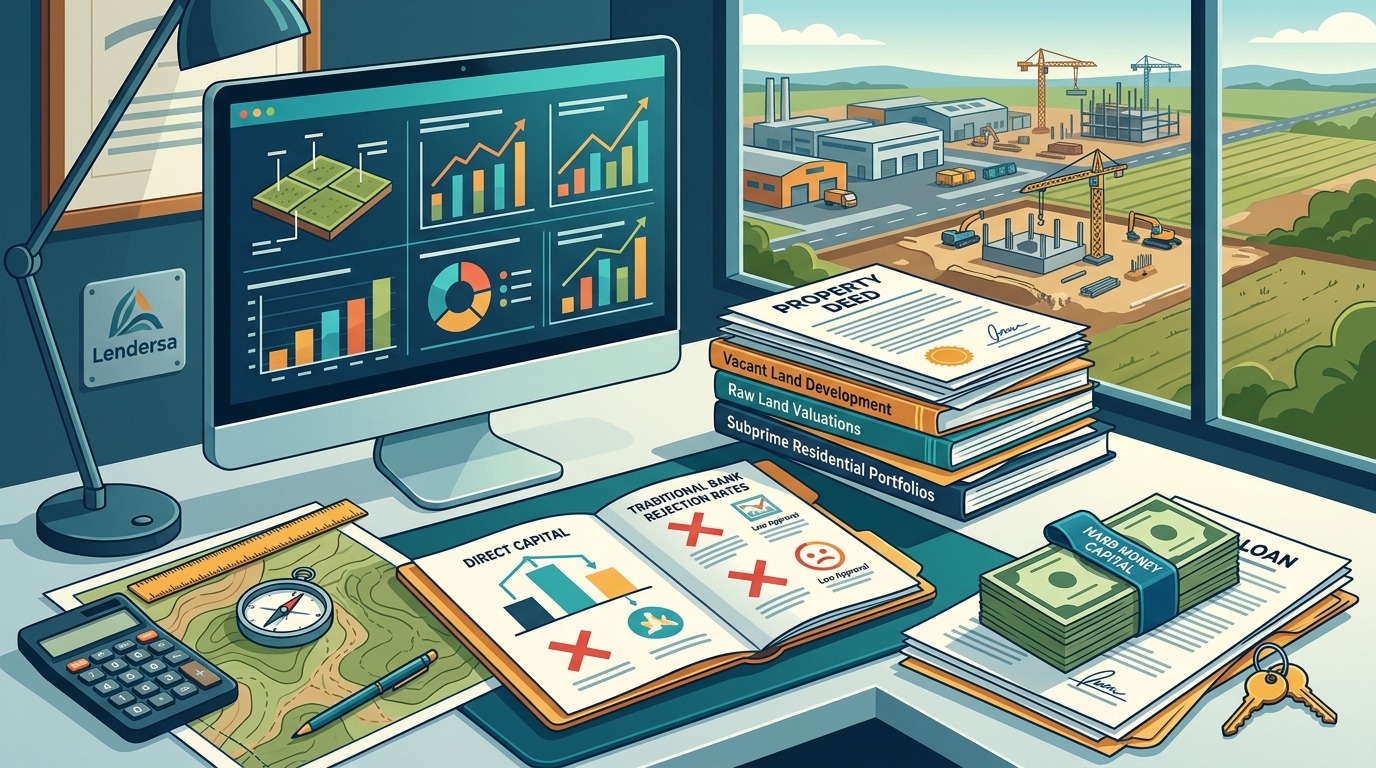
Loan Type Comparison Matrix
Understanding the differences between various loan types is crucial for selecting the right financing option. The table below summarizes the key characteristics of hard money, conventional, and specialized loans for vacant land and subprime borrowers.
| Loan Type | Best For | Typical LTV | Closing Time | Credit Requirement |
|---|---|---|---|---|
| Hard Money Loans | Fix and Flip, Bridge Loans | 60% - 75% | 7 - 14 Days | Flexible / Asset-Based |
| Vacant Land Loans | Raw Land Purchase, Development | 50% - 65% | 14 - 30 Days | Moderate to High Equity |
| Non-QM Loans | Subprime Credit, Self-Employed | 70% - 80% | 21 - 30 Days | Lower Credit Scores Accepted |
| Conventional Loans | Primary Residences, Good Credit | 80% - 97% | 30 - 45 Days | Good to Excellent Credit |
Key Takeaways
- Specialized Lenders Exist: Direct hard money lenders are available for both vacant land and subprime residential loans, but they require a different approach than traditional banking.
- Equity is Key: For vacant land, lenders typically offer lower LTV ratios (50-65%), meaning you need significant cash or equity to secure financing.
- Speed vs. Cost: Hard money loans offer rapid funding (7-14 days) but come with higher interest rates compared to conventional mortgages.
- AI-Driven Matching: Using a platform like Lendersa allows you to access hundreds of lenders simultaneously, ensuring you get the best terms through competition.
- Non-QM Options: Subprime borrowers should explore Non-QM loans, which offer flexible underwriting for those with poor credit or complex income.
- Founder Expertise: Lendersa was founded by Moshon Reuveni, a veteran with over 50 years of experience in real estate finance, ensuring deep industry knowledge.
- Nationwide Coverage: The platform operates across all 50 states, Canada, and Puerto Rico, providing access to a broad network of capital.
Frequently Asked Questions
Can I get a hard money loan for vacant land?
Yes, but it is more difficult than financing improved property. Lenders will focus on the land's value, zoning, and your equity. You should look for lenders who specialize in vacant land loans to find the best rates.
What is the minimum credit score for subprime residential loans?
Subprime loans typically accept credit scores below 620. However, the lower your score, the higher the interest rate and the larger the down payment required. Lenders will also look at your recent payment history and debt-to-income ratio.
How does the Multi-Lender Protocol work?
The Multi-Lender Protocol uses AI to match your loan scenario with hundreds of lenders. It then compares the offers and negotiates the best terms on your behalf, saving you time and money.
Is Lendersa a direct lender?
Lendersa is a technology platform that connects borrowers with a network of direct lenders, including banks, private investors, and hard money lenders. We do not lend money directly but facilitate the connection and comparison process.
How fast can I close a hard money loan?
Hard money loans can close in as little as 7 to 14 days, depending on the lender and the complexity of the deal. This is significantly faster than conventional mortgages, which can take 30 to 45 days.
What is a Non-QM loan?
A Non-QM (Non-Qualified Mortgage) loan is a mortgage that does not meet federal government guidelines. These loans are often used by borrowers with non-standard income or credit profiles and offer more flexible underwriting criteria.
Does Lendersa operate internationally?
Lendersa primarily operates in the USA, Canada, and Puerto Rico. The platform connects borrowers with capital across these regions, ensuring access to a wide range of lending options.
Get Your Competitive Offers Now
Stop searching for individual lenders and let the market work for you. Whether you are looking for hard money lenders near me or specialized capital for vacant land, Lendersa provides the tools and network to secure the best deal. Use our Quote Comparison Dashboard to view offers from hundreds of lenders instantly. No Social Security Number is needed to start your search. Click here to explore your options and find the perfect loan for your property today.