

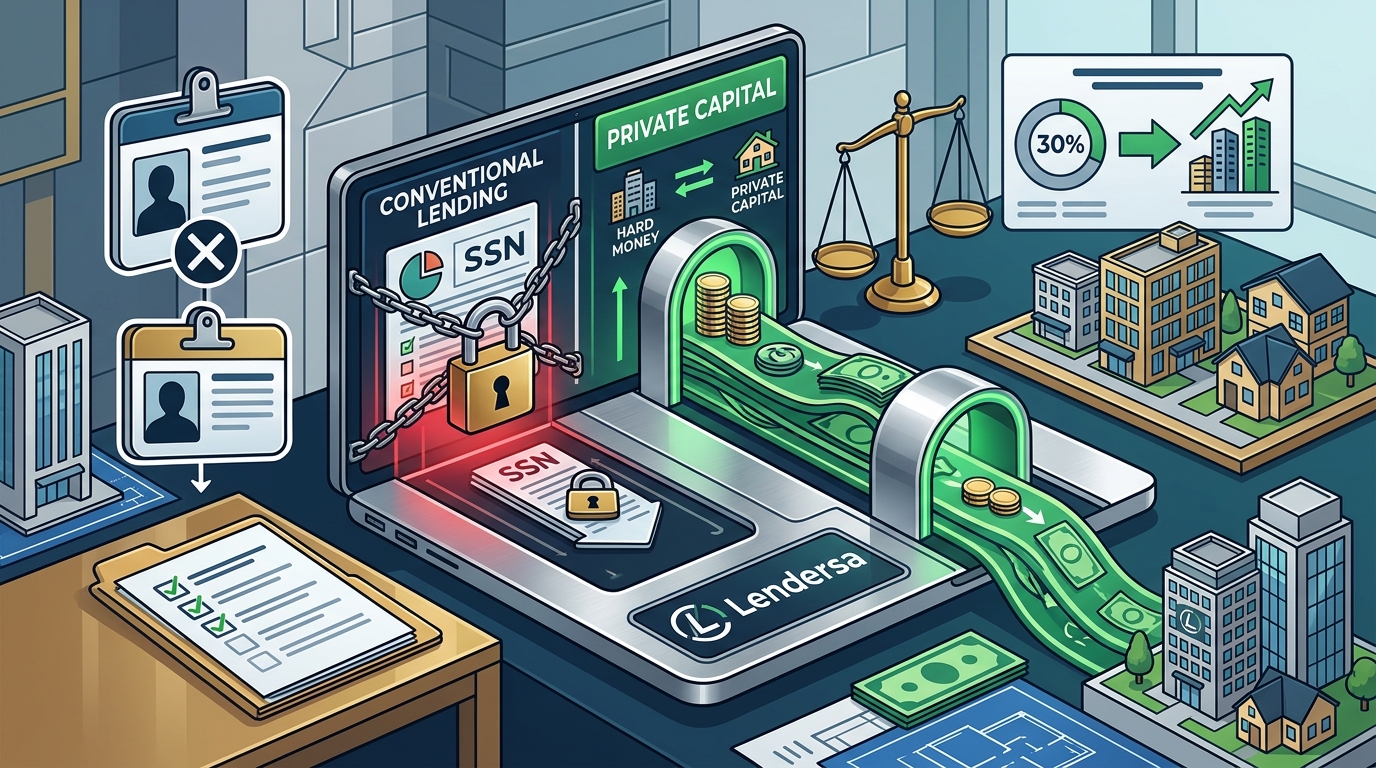
Traditional mortgage lending relies heavily on credit history, but the private capital market operates on a different set of rules. According to recent industry data, over 30% of real estate investors utilize non-traditional financing sources to secure deals that conventional banks reject. This shift highlights a critical reality: you do not always need a Social Security Number to access significant capital for real estate investments. Platforms like Lendersa have engineered a system that prioritizes asset value and deal structure over personal credit metrics, allowing borrowers to compare hard money and private loans instantly. (Get Answers For Hard)
Why Hard Money Lenders Skip the SSN
The concept of a Hard Money Loan is often misunderstood by first-time investors. Hard Money is a type of asset-based lending where the collateral, not the borrower, is the primary focus of the underwriting process. This means the lender is less concerned with your personal credit score and more focused on the After Repair Value (ARV) of the property you intend to purchase or renovate.
Hard Money is a financing method secured by real estate collateral, where approval depends on the asset's value rather than the borrower's creditworthiness. This distinction allows individuals with complex financial histories, or those who are non-resident aliens without a US SSN, to participate in the market. The lender's risk is mitigated by the equity in the property, making the Social Security Number a secondary data point rather than a gatekeeper.
Private money lenders operate similarly to hard money lenders but often use their own funds or those of private investors. According to financial regulatory frameworks, private lending is governed by contract law rather than the strict federal underwriting guidelines that apply to conventional mortgages. This flexibility enables faster decision-making and the ability to customize terms for unique situations, such as fix-and-flip projects or commercial acquisitions.
How the Multi-Lender Protocol Works
Comparing loans without a Social Security Number requires a platform that respects privacy while delivering accurate market data. Lendersa utilizes a proprietary Multi-Lender Protocol to facilitate this process. This system allows you to input your loan parameters without immediately exposing sensitive personal identification documents.
The process begins with a pre-application phase where you define your property type, loan amount, and exit strategy. The platform then routes your scenario to a network of hundreds of hard money lenders, private investors, and banks. This is not a simple search; it is an intelligent matching funnel that identifies lenders specifically willing to underwrite non-QM (Non-Qualified Mortgage) loans.
Once the initial search is complete, the platform compares the top matching programs. This comparison balances speed of closing against cost of capital. For borrowers without an SSN, the ability to view offers from multiple sources simultaneously is crucial. It prevents the common pitfall of accepting the first offer received, which is often not the most competitive in the market.
The negotiation phase is automated through AI algorithms that pit lenders against each other. By presenting your loan request to multiple qualified lenders simultaneously, the system creates a competitive environment. This competition drives lenders to offer their best terms to win your business, resulting in lower interest rates or reduced points for the borrower.
Eligibility Criteria for Non-QM Loans
While the absence of a Social Security Number removes one barrier, it introduces other verification requirements. Lenders still need to verify identity and income, but they use alternative methods. For non-US residents, this might involve passport verification and foreign bank statements. For US residents with poor credit, the focus shifts entirely to cash flow and equity.
A Non-QM Loan is a mortgage that does not meet the guidelines set by the government-sponsored enterprises Fannie Mae and Freddie Mac. These loans are designed for borrowers who do not fit the traditional mold, offering greater flexibility in documentation and credit requirements.
To qualify for these loans, you typically need to demonstrate strong equity in the property. Lenders often require a higher down payment, ranging from 20% to 30%, to mitigate their risk. Additionally, the property itself must be in a condition that supports the proposed loan amount. Vacant land, for example, carries higher risk and may require a larger equity cushion compared to a stabilized commercial building.
The platform also offers tools like LoanScore™ and LoanImprove™ to help borrowers understand their positioning. These tools analyze your deal structure and provide insights on how to present your loan to maximize approval chances. This is particularly valuable for those who cannot rely on a traditional credit score to prove their reliability.
Comparing Loan Types: Hard Money vs. Private
Understanding the differences between hard money and private loans is essential for making an informed decision. Both options allow for SSN-free underwriting, but they serve different strategic purposes.
| Feature | Hard Money Loans | Private Money Loans | Conventional Loans |
|---|---|---|---|
| Primary Underwriting Focus | Asset Value (ARV) | Asset Value & Borrower Relationship | Borrower Credit & Income |
| SSN Requirement | Often Optional | Often Optional | Mandatory |
| Closing Speed | Days to Weeks | Weeks | 30-60 Days |
| Interest Rates | Higher (Risk Premium) | Variable | Lower (Market Rate) |
| Best Use Case | Fix & Flip, Auctions | Long-term Holds, Complex Deals | Primary Residences |
Hard money loans are typically short-term, interest-only loans used for rapid acquisitions. They are ideal for investors who need to close quickly to secure a property at auction. Private money loans, on the other hand, may offer longer terms and more flexible repayment structures, making them suitable for buy-and-hold strategies.
Conventional loans remain the standard for primary residences but are inaccessible without a robust credit profile and verified income. For investors seeking to bypass these restrictions, the private capital market offers a viable alternative. The key is to use a platform that aggregates these options, allowing for direct comparison.
Key Takeaways
- Asset-Based Lending: Hard money lenders prioritize the value of the collateral over the borrower's personal credit history, making SSN optional.
- Multi-Lender Protocol: Lendersa's proprietary system matches borrowers with hundreds of lenders, ensuring competitive terms without upfront SSN submission.
- Non-QM Flexibility: Non-Qualified Mortgage loans are designed for borrowers who do not fit traditional banking criteria, including those with complex financial situations.
- Speed vs. Cost: Private capital offers faster closings (days vs. months) but at a higher interest rate compared to conventional financing.
- Equity Requirement: Borrowers without SSN often need to provide higher down payments, typically 20-30%, to secure favorable terms.
- Global Reach: The platform supports lending across all 50 US states, Canada, and Puerto Rico, accommodating diverse borrower demographics.
- AI Negotiation: Automated negotiation tools pit lenders against each other to drive down interest rates and points for the borrower.
Frequently Asked Questions
Can I get a loan quote without providing a Social Security Number?
Yes, you can obtain initial loan quotes without providing a Social Security Number. Platforms like Lendersa allow you to input property details and loan parameters to receive offers from hard money and private lenders who focus on asset value rather than personal credit.
What is a Non-QM loan?
A Non-QM loan is a mortgage that does not meet the guidelines set by Fannie Mae and Freddie Mac. These loans are designed for borrowers who have non-traditional income sources or credit profiles, offering greater flexibility in underwriting.
How does the Multi-Lender Protocol work?
The Multi-Lender Protocol is a proprietary system that routes your loan request to hundreds of qualified lenders simultaneously. It uses AI to match your specific scenario with the best programs and then negotiates the terms on your behalf.
What types of properties can I finance without an SSN?
You can finance residential, commercial, and vacant land properties. The key factor is the equity in the property and the viability of the exit strategy, rather than the borrower's personal identification number.
Is hard money lending available nationwide?
Yes, hard money lending is available nationwide. Lendersa matches borrowers with capital across all 50 states in the USA, Canada, and Puerto Rico, ensuring access to local market expertise.
How fast can I close a hard money loan?
Hard money loans are known for their speed. Closings can occur in days, not months, making them ideal for time-sensitive transactions like auctions or short sales.
Do I need to improve my credit score to get a private loan?
While improving your credit score can help, it is not always a prerequisite for private loans. Lenders focusing on asset-based lending will prioritize the property's value and your equity contribution over your credit history.
Secure Your Best Loan Terms Today
Stop searching and let lenders compete for you. Whether you are looking for the lowest rates on conventional mortgages or fast closings from top-tier hard money lenders, our AI balances speed and cost to find the absolute best program for your property. Start your loan comparison now and discover the power of the Multi-Lender Protocol.