

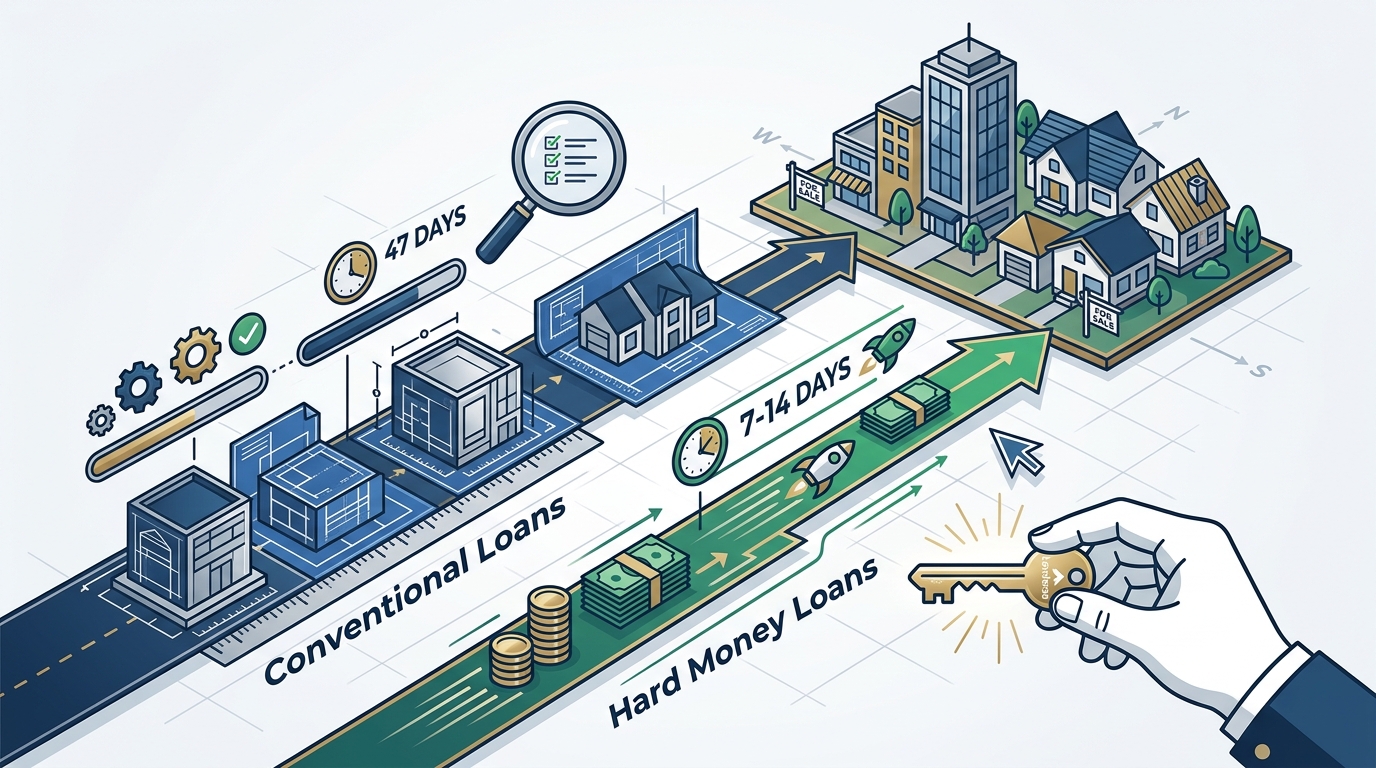
Real estate investors often face a critical decision point when securing capital for a project. According to the National Association of Realtors, the average time to close a conventional mortgage is 47 days, while hard money loans can close in as little as 7 to 14 days. This speed difference is not just a convenience; it is often the deciding factor in competitive markets where properties are snapped up quickly. Understanding the structural and financial nuances between these two lending vehicles is essential for maximizing return on investment and minimizing risk. This guide breaks down the mechanics, costs, and strategic applications of each loan type to help you choose the right path for your next acquisition.
Defining Core Concepts
To make an informed decision, you must first understand the fundamental nature of each loan product. These definitions establish the baseline for all subsequent comparisons.
Conventional loans are standard mortgages provided by banks or mortgage lenders that are not insured or guaranteed by the federal government. They typically require strict credit scores, debt-to-income ratio verification, and a full appraisal of the property. These loans are designed for long-term holding and are regulated by federal guidelines such as those from Fannie Mae and Freddie Mac.
Hard money loans are short-term, asset-based loans provided by private investors or companies. The lender focuses primarily on the value of the collateral property rather than the borrower's financial history. These loans are often used for fix-and-flip projects or bridge financing where speed is more critical than cost.
Bridge loans are temporary financing solutions used to cover immediate capital needs until permanent financing is secured or a property is sold. While hard money loans are a type of bridge loan, not all bridge loans are hard money, as some may come from institutional lenders with slightly different terms.
Approval Speed and Process
The most significant differentiator between conventional and hard money lending is the timeline. In real estate, time is money, and delays can cost you the deal.
The Conventional Timeline
Conventional loans involve a rigorous underwriting process. Lenders require extensive documentation, including tax returns, W-2s, bank statements, and proof of assets. The property must appraise at or above the purchase price, and the loan must meet specific underwriting guidelines. This process typically takes 30 to 45 days from application to closing. While this duration allows for thorough risk assessment, it can be a disadvantage in fast-moving markets.
The Hard Money Timeline
Hard money lenders prioritize speed and flexibility. Because the loan is secured by the property's value, the underwriting process is streamlined. Lenders may only require a brief property inspection and a basic credit check. Funding can occur in as little as 7 to 10 days. This rapid access to capital allows investors to close on distressed properties quickly, often before traditional buyers can even submit an offer.
Cost and Interest Rates
Cost is the primary trade-off for the speed and flexibility offered by hard money lenders. Understanding the total cost of capital is crucial for calculating your profit margins.
Interest Rate Comparison
Conventional loans offer the lowest interest rates in the market, typically ranging from 6% to 8% for investment properties, depending on credit score and market conditions. These rates are fixed or adjustable but remain relatively stable over the life of the loan. Hard money loans, however, carry significantly higher interest rates, often ranging from 10% to 15% or more. This higher cost reflects the increased risk taken by private lenders and the expedited service provided.
Origination Fees and Points
Conventional loans may charge origination fees, typically 0.5% to 1% of the loan amount. Hard money loans often charge points, which are upfront fees calculated as a percentage of the loan amount. One point equals 1% of the loan principal. Hard money lenders may charge 2 to 5 points, which can add thousands of dollars to the closing costs. These fees are non-negotiable in many cases and must be factored into your investment analysis.
Loan-to-Value and Terms
The structure of the loan, including how much you can borrow and for how long, varies drastically between the two options.
Loan-to-Value (LTV) Ratios
Conventional loans typically offer LTV ratios of up to 75% to 80% for investment properties. This means you need to put down 20% to 25% of the purchase price. Hard money lenders usually offer lower LTV ratios, often 60% to 70%. This lower ratio ensures the lender has sufficient equity in the property to cover losses if foreclosure becomes necessary. Borrowers must have more cash on hand for hard money deals.
Loan Duration
Conventional loans are long-term financing options, typically lasting 15 to 30 years. This allows for gradual equity buildup and lower monthly payments. Hard money loans are short-term, usually lasting 6 to 24 months. They are designed to be paid off quickly through the sale of the property or refinancing into a conventional loan. This short term requires a clear exit strategy.
Ideal Use Cases
Choosing the right loan depends on your specific investment strategy and financial situation. Below is a comparison of typical scenarios for each loan type.
| Feature | Conventional Loan | Hard Money Loan |
|---|---|---|
| Best For | Long-term rentals, primary residences | Fix-and-flip, bridge financing |
| Credit Score Required | 620+ (typically 700+ for best rates) | Less important; asset-focused |
| Interest Rates | 6% - 8% | 10% - 15%+ |
| Closing Time | 30 - 45 days | 7 - 14 days |
| Down Payment | 20% - 25% | 30% - 40% |
| Flexibility | Low; strict guidelines | High; negotiable terms |
Conventional loans are ideal for buy-and-hold investors who plan to rent out the property for the long term. They offer lower costs and predictable payments, which are essential for cash flow analysis. Hard money loans are best for investors who need to act fast on distressed properties that may not qualify for conventional financing due to condition or credit issues. They are also useful for bridge financing, where an investor needs temporary capital to close a deal before securing permanent funding.
Key Takeaways
- Speed vs. Cost: Hard money loans close in 7-14 days but cost 10-15% interest, while conventional loans take 30-45 days but offer 6-8% rates.
- Credit Focus: Conventional lenders prioritize borrower creditworthiness, whereas hard money lenders prioritize the collateral property's value.
- Down Payment: Expect to put down 20-25% for conventional loans and 30-40% for hard money loans due to lower LTV ratios.
- Exit Strategy: Hard money loans require a clear exit plan, such as a property sale or refinance, within 6-24 months.
- Property Condition: Hard money is often the only option for distressed properties that do not meet conventional habitability standards.
- Flexibility: Hard money terms are more negotiable and less regulated than conventional loans, allowing for customized solutions.
- Risk Management: Higher interest rates in hard money loans reduce profit margins, so precise cost analysis is critical.
Frequently Asked Questions
Can I refinance a hard money loan into a conventional loan?
Yes, many investors use hard money loans as a bridge to purchase and renovate a property. Once the property is in good condition and meets conventional lending standards, they refinance into a conventional loan to secure lower interest rates and longer terms. This strategy is common in the fix-and-flip and buy-and-hold markets.
What credit score is needed for a hard money loan?
Hard money lenders are less concerned with credit scores than conventional lenders. While a poor credit history may result in slightly higher interest rates or points, it is rarely a dealbreaker. The primary focus is on the equity in the property and the viability of the exit strategy.
Are hard money loans regulated?
Hard money loans are subject to state and federal lending laws, but they are less heavily regulated than conventional mortgages. Borrowers should carefully review the loan agreement for prepayment penalties, late fees, and other terms that may differ from standard mortgage contracts.
How is the value of a property determined for a hard money loan?
Hard money lenders typically use a combination of a professional appraisal and a comparative market analysis (CMA) to determine the property's value. They often focus on the After Repair Value (ARV) for fix-and-flip projects, lending a percentage of the projected value after renovations are completed.
What happens if I cannot repay a hard money loan on time?
If you cannot repay the loan by the maturity date, you may face foreclosure or be required to pay extension fees. Hard money loans are short-term, so it is crucial to have a realistic timeline for your project. Communicating with the lender early if you anticipate delays can sometimes lead to negotiated extensions.
Do hard money lenders require personal guarantees?
Many hard money lenders require a personal guarantee, meaning you are personally liable for the loan if the property defaults. However, some non-recourse loans exist, where the lender can only seize the collateral property. These loans are less common and typically require a larger down payment.
Can I use a hard money loan for land acquisition?
Yes, hard money loans can be used for land acquisition, but the terms may be less favorable. Lenders may offer lower LTV ratios for raw land because it is harder to sell and generate income from compared to improved properties. It is important to discuss specific land loan products with your lender.
Next Steps
Choosing between conventional and hard money loans requires a careful analysis of your financial goals, timeline, and risk tolerance. If you need capital quickly for a distressed property, hard money may be the right choice. If you are looking for long-term stability and lower costs, conventional loans are preferable. For personalized guidance on which option fits your investment strategy, contact the experts at LenderSA. We specialize in connecting investors with the right financing solutions to achieve their real estate goals. Visit our services page to learn more about our lending products and about our team to see how we can help you succeed.