

Starting a financing search does not have to mean applying blindly to one bank, waiting for a decision, and then beginning again after a rejection. A more effective approach is to organize your property and project information first, identify the types of capital that may fit, and compare multiple lenders using consistent assumptions.
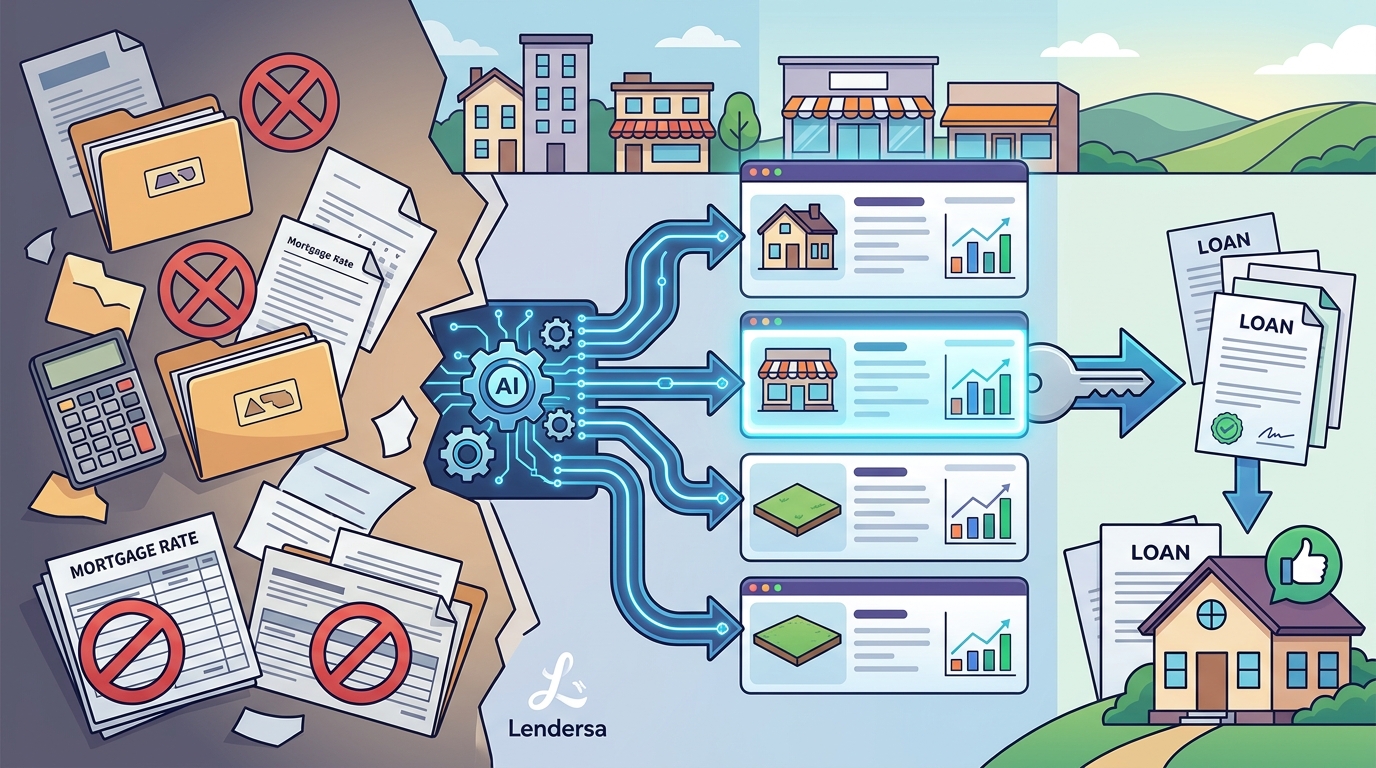
Lendersa is designed to help borrowers compare conventional and hard money financing options across residential, commercial, and vacant land transactions. Its AI-assisted marketplace helps route a financing scenario toward lenders that may be relevant to the property, location, loan purpose, and borrower profile. You can begin the initial comparison process without providing a Social Security number, although a lender may request additional identifying, financial, and credit information later in the underwriting process. Get Answers For Hard if you need help understanding which financing path may fit your situation.
The goal is not simply to find the lowest advertised interest rate. The right comparison considers total borrowing cost, leverage, repayment schedule, closing speed, documentation requirements, collateral, exit strategy, and the lender’s ability to close when your transaction requires it. The Consumer Financial Protection Bureau recommends comparing multiple offers and making sure the proposed loans are sufficiently alike for an apples-to-apples evaluation. ([consumerfinance.gov](https://www.consumerfinance.gov/consumer-tools/mortgages/shopping-for-a-mortgage/?utm_source=openai))
1. Define the financing request before contacting lenders
The first practical step is to turn a general objective—such as “I need money for a property”—into a defined financing request. Lenders price and approve loans according to the property, intended use, requested amount, repayment plan, and risk characteristics. The more precise your request, the more useful the comparison results are likely to be.
Identify the property category
- Residential: A primary residence, second home, single-family rental, duplex, triplex, fourplex, condominium, or manufactured home.
- Commercial: Multifamily properties with more than four units, retail, office, industrial, hospitality, mixed-use, or other income-producing real estate.
- Vacant land: Raw land, improved land, buildable lots, agricultural acreage, or land intended for future development.
- Construction or renovation: Ground-up construction, major rehabilitation, fix and flip, bridge financing, or a refinance tied to improvements.
Property classification affects appraisal requirements, permitted loan structures, collateral analysis, reserves, construction draws, and lender eligibility. A vacant parcel with no utilities, for example, may be evaluated very differently from a finished lot with approved plans and nearby services.
State the loan purpose and exit strategy
Explain exactly what the proceeds will accomplish. Common purposes include acquisition, refinance, cash-out refinance, construction, renovation, bridge financing, debt consolidation secured by real estate, or working capital for a commercial project.
Then describe how the loan will be repaid. An exit strategy may be the sale of a renovated property, a refinance into permanent financing, repayment from operating income, the sale of another asset, or a planned capital event. A short-term fix and flip loan may be appropriate when the borrower expects to renovate and sell, while a stabilized rental may call for longer-term conventional, portfolio, or non-QM financing.
Set the core request variables
Before submitting a scenario, write down:
- Target purchase price or current property value.
- Requested loan amount.
- Estimated cash contribution or available equity.
- Desired term and amortization period.
- Target closing date.
- Expected renovation or construction budget.
- Projected value after improvements, if applicable.
- Expected rental income, operating income, or resale value.
- Preferred repayment structure and acceptable flexibility.
This preparation prevents a common mistake: comparing lenders using different loan amounts, values, terms, or assumptions. Offers that appear different may simply be based on different inputs.
2. Assemble a lender-ready information package
You do not need a perfect file to begin an initial comparison, but you should provide accurate information. Incomplete or inconsistent data can produce unrealistic pricing, mismatched lender results, or delays when a lender begins formal underwriting.
Property information
Gather the property address or target market, property type, occupancy status, purchase contract if available, current mortgage balance, estimated value, tax information, insurance details, photographs, rent roll, leases, operating statements, zoning information, and title details. Commercial and land transactions may also require surveys, environmental reports, entitlement information, plans, permits, and utility documentation.
Project economics
For renovation and construction projects, prepare a line-item budget rather than a single estimated figure. Include acquisition costs, labor, materials, permits, professional fees, financing costs, contingency reserves, holding costs, insurance, taxes, utilities, and projected selling expenses.
If the project involves an After Repair Value, or ARV, support the estimate with comparable sales, a broker opinion, an appraisal, or a clearly explained valuation method. Lenders may not accept an optimistic ARV without evidence.
Borrower and guarantor information
Depending on the loan program, lenders may review credit history, liquidity, experience, income, assets, liabilities, entity documents, tax returns, bank statements, and personal financial statements. Asset-based lenders may place greater emphasis on collateral and equity than conventional lenders, but that does not mean borrower information is irrelevant. Personal guarantees, repayment capacity, experience, and liquidity can still affect approval, pricing, and structure.
Use consistent and truthful data
Do not inflate the property value, understate the renovation budget, or omit existing liens. A comparison built on inaccurate assumptions is not a financing solution. It may also create avoidable problems during appraisal, title review, underwriting, or closing.
3. Understand the financing categories you are comparing
Financing comparison is most useful when you understand what each capital source is designed to accomplish.
Conventional and traditional financing
Conventional loans generally emphasize borrower credit, income, employment, debt obligations, property eligibility, documentation, and long-term repayment capacity. They may offer lower interest rates than short-term private capital, but qualification can be more documentation-intensive and closing timelines may be less flexible for unusual properties or time-sensitive acquisitions.
Hard money financing
Hard money loans are commonly short-term, real-estate-secured loans where collateral value, loan-to-value ratio, project economics, and the borrower’s plan are central to the underwriting decision. They may be useful for bridge transactions, distressed acquisitions, construction, renovation, auction purchases, and borrowers who do not fit conventional documentation standards. The tradeoff can include higher rates, points, fees, shorter terms, interest-only payments, extension charges, or more significant equity requirements.
Private and portfolio capital
Private lenders and portfolio lenders may have more flexibility than standardized institutional programs. They may consider unique property types, business-purpose transactions, investor experience, or customized collateral structures. Flexibility varies widely, so borrowers should review the lender’s track record, legal documents, fees, servicing process, and funding capacity.
The best option depends on the transaction rather than on a label. A lower-rate loan that cannot close before a contract deadline may be less valuable than a higher-cost loan that funds a profitable opportunity. Conversely, using expensive short-term capital for a property that qualifies for affordable long-term financing can unnecessarily reduce returns.
4. Run an initial eligibility and scenario check
Before requesting formal lender proposals, use available diagnostic resources to identify potential weaknesses in the scenario. On Lendersa, borrowers can explore tools such as LoanScore™ and LoanImprove™ as part of the preparation process.
LoanScore™ is described as a proprietary measure intended to help evaluate how a financing profile may align with available lending programs. LoanImprove™ is intended to help borrowers identify ways to strengthen the profile or improve the quality of the financing request. These tools should be treated as screening and preparation resources—not as guarantees of approval, rate, loan amount, or closing.
Questions to answer during the diagnostic stage
- Is the requested leverage reasonable for this property and loan purpose?
- Is the value supported by credible market evidence?
- Does the borrower have enough liquidity for down payment, closing costs, reserves, and overruns?
- Is the project budget complete and realistic?
- Is the expected exit strategy plausible within the proposed term?
- Would a conventional, private, hard money, bridge, construction, or land program be more appropriate?
- Are there title, zoning, environmental, occupancy, or insurance issues that could affect eligibility?
Early diagnosis can help you correct missing information before lenders review the request. It can also prevent you from focusing on a program whose requirements do not match the transaction.
5. Submit the scenario to a multi-lender comparison marketplace
Once the request is defined and the supporting information is organized, submit the scenario through a multi-lender marketplace rather than relying only on one lender. Lendersa’s model is intended to connect financing opportunities with capital providers across residential, commercial, and vacant land sectors.
The comparison process may use property type, location, requested leverage, loan purpose, borrower characteristics, project details, and other information to identify lenders that may be relevant. This can reduce the manual work involved in searching for specialized financing, including geographic searches such as fix and flip lenders by state.
An initial marketplace inquiry does not mean every lender will approve the loan or that every displayed result is a final commitment. Treat early matches as opportunities for further discussion. A lender may still require an application, credit authorization, appraisal, title work, entity documents, insurance, verification of funds, or other underwriting materials.
Why begin without an SSN?
Allowing borrowers to begin with property and transaction information can make early exploration more convenient and reduce the need to distribute sensitive personal information before a borrower has identified potentially relevant programs. However, no-SSN initial access should not be confused with no underwriting. A lender may require a Social Security number, tax identification number, credit report, identity verification, or other documentation before issuing a formal approval or closing a loan.
6. Compare proposals using the same assumptions
When lender responses arrive, place them into a comparison worksheet or dashboard. Evaluate each proposal using the same loan amount, property value, term, and project assumptions whenever possible.
Compare the economics
- Interest rate: Confirm whether the rate is fixed, adjustable, interest-only, or subject to a pricing adjustment.
- Annual percentage rate: For applicable consumer mortgage products, APR can help account for interest and certain fees when comparing options, although it does not replace a complete review of the loan documents. ([consumerfinance.gov](https://www.consumerfinance.gov/owning-a-home/explore/learn-about-loan-costs/?utm_source=openai))
- Points and origination charges: Determine whether points are paid upfront and whether the lender charges separate underwriting, processing, application, document, or administration fees.
- Loan-to-value or loan-to-cost: Confirm whether leverage is calculated using current value, purchase price, ARV, total project cost, or another measure.
- Monthly payment: Identify principal and interest, interest-only payments, amortization, balloon balances, reserves, and escrow obligations.
- Cash to close: Include down payment, lender fees, third-party costs, prepaid items, reserves, and required equity contributions.
- Total borrowing cost: Estimate interest, points, fees, extension costs, exit fees, prepayment charges, and anticipated holding-period expenses.
Compare the structure and execution risk
- Loan term and extension options.
- Funding time and closing conditions.
- Draw procedures for construction or renovation.
- Inspection and approval requirements before each draw.
- Minimum interest or minimum loan period.
- Prepayment penalties or yield maintenance.
- Default interest, late charges, and remedies.
- Personal guarantees and recourse provisions.
- Required reserves and liquidity tests.
- Appraisal, title, environmental, insurance, and legal requirements.
- Whether the lender has actually funded similar properties and loan sizes.
For consumer mortgage transactions, the CFPB advises reviewing the loan amount, interest rate, monthly payment, upfront costs, lender credits, cash to close, and the projected cost of borrowing. It also warns that a “no closing cost” loan may shift costs into a higher interest rate or larger loan balance rather than eliminating them. ([consumerfinance.gov](https://www.consumerfinance.gov/owning-a-home/compare/compare-loan-estimates/?utm_source=openai))
Example: why the lowest rate may not be the lowest-cost option
Assume two lenders offer a $300,000 loan. Lender A offers a lower rate but charges four points, a large exit fee, and requires a six-month minimum interest period. Lender B offers a higher rate but charges one point, permits early repayment without a penalty, and can fund within the borrower’s purchase-contract deadline. If the property is expected to sell in 90 days, Lender B may produce a lower total project cost even though its nominal rate is higher.
7. Negotiate the terms and verify the lender before proceeding
Multiple proposals create leverage, but negotiation should focus on the complete structure rather than one attractive line item. Ask whether the lender can reduce points, lower the rate, increase proceeds, shorten the closing timeline, remove an unnecessary fee, improve draw terms, or provide a more favorable extension provision.
The CFPB specifically recommends using competing Loan Estimates to negotiate and cautions borrowers to check that a reduction in one fee is not offset by an increase elsewhere. ([consumerfinance.gov](https://www.consumerfinance.gov/consumer-tools/mortgages/shopping-for-a-mortgage/?utm_source=openai))
Questions to ask each lender
- Is this a preliminary indication, term sheet, preapproval, commitment, or final approval?
- What conditions remain before funding?
- What fees are refundable or nonrefundable?
- When are fees due, and who receives them?
- What happens if the appraisal is below the expected value?
- How are construction or renovation draws requested and released?
- Can the loan be extended, and what is the extension pricing?
- Are there prepayment, exit, minimum-interest, or default charges?
- Will the lender require a personal guarantee or additional collateral?
- Who will service the loan after closing?
- Is the lender authorized or appropriately registered for the transaction and jurisdiction?
For applicable mortgage professionals, the CFPB notes that licensing or registration information may be checked through the Nationwide Mortgage Licensing System and Registry. Borrowers should also independently verify wire instructions, legal entities, contact information, and the identity of the party requesting funds. ([consumerfinance.gov](https://www.consumerfinance.gov/owning-a-home/loan-estimate/?utm_source=openai))
Common mistakes that weaken the comparison process
Comparing unlike loans
A 30-year amortizing conventional mortgage should not be compared with a six-month interest-only bridge loan solely by interest rate. The products serve different purposes and expose the borrower to different repayment risks.
Focusing only on the advertised rate
Rates can obscure points, lender fees, mortgage insurance, reserves, prepayment penalties, balloon payments, and extension costs. Review the complete term sheet or Loan Estimate.
Using an unsupported ARV or income projection
Overstated value and revenue assumptions can make a project look financeable when it is not. Use conservative comparable sales, realistic rents, documented expenses, and a contingency reserve.
Ignoring the exit strategy
A short-term loan requires a credible repayment plan. If the sale or refinance takes longer than expected, extension fees and additional interest can materially reduce returns.
Submitting incomplete information
Missing addresses, unclear ownership, inconsistent loan amounts, or absent project budgets can lead to poor matches and repeated requests for clarification.
Assuming an initial match is a commitment
AI matching can identify potential lender fit, but it does not replace underwriting, valuation, title review, legal documentation, or final lender approval.
Paying suspicious upfront fees
Be cautious of anyone promising guaranteed approval or demanding substantial payment before providing verifiable loan terms. The Federal Trade Commission warns that advance-fee loan offers can be scams and advises consumers to walk away when a purported lender requires money upfront before a real loan exists. ([consumer.ftc.gov](https://consumer.ftc.gov/credit-loans-and-debt/loans-and-mortgages?utm_source=openai))
Letting urgency eliminate due diligence
Speed matters in auctions, distressed acquisitions, and contract deadlines, but rushed borrowing can create expensive problems. Read the note, mortgage or deed of trust, guaranty, fee schedule, default provisions, and closing instructions before signing. Consider consulting a qualified real estate attorney, tax professional, or financial adviser for complex transactions.
A practical financing-comparison checklist
- Describe the asset: Identify property type, location, occupancy, current value, purchase price, and ownership structure.
- Define the purpose: State whether the request is for acquisition, refinance, construction, renovation, bridge financing, land, or another purpose.
- Calculate the capital need: Include purchase price, improvements, closing costs, reserves, and carrying costs.
- Document value: Prepare comparable sales, appraisal information, ARV support, rent data, or operating statements.
- Explain repayment: Identify the expected sale, refinance, operating-income repayment, or other exit.
- Run a diagnostic: Use tools such as LoanScore™ and LoanImprove™ to identify possible weaknesses before submission.
- Submit for matching: Start the Lendersa comparison process and provide accurate scenario data.
- Request comparable proposals: Ask lenders to quote the same amount, term, value basis, and repayment structure.
- Build a total-cost comparison: Include rate, points, fees, reserves, penalties, extension costs, and expected interest.
- Verify execution: Confirm lender identity, licensing where applicable, conditions, closing timeline, and funding process.
- Negotiate and choose: Select the offer that best balances cost, certainty, flexibility, and transaction fit.
Key takeaways
- Start with a defined scenario: Property type, loan purpose, leverage, budget, timeline, and exit strategy determine which lenders are relevant.
- Prepare property and project data: Accurate value, ARV, budget, rent, income, and title information improve the quality of lender responses.
- Compare more than rates: Points, fees, repayment structure, reserves, prepayment provisions, and extension costs can change the true economics.
- Use AI as a screening and matching tool: AI can reduce manual lender searching, but final approval remains subject to lender underwriting and documentation.
- Conventional and hard money serve different purposes: Conventional financing may prioritize cost and documentation, while hard money may prioritize speed, collateral, and flexibility.
- Initial comparison can begin without an SSN: Sensitive information may still be required later for credit, identity, compliance, and underwriting.
- Negotiation works best with comparable proposals: Multiple written offers help you ask lenders to improve pricing or structure.
- Protect yourself: Verify lender identity, read the full documents, and avoid guaranteed-approval or suspicious advance-fee claims.
Frequently asked questions
What information is needed to start a financing comparison?
Begin with the property type, location, estimated value or purchase price, requested loan amount, loan purpose, desired timeline, available equity, renovation or construction budget, and expected repayment strategy. More detailed borrower, credit, income, asset, title, appraisal, and entity information may be requested when a lender moves the request into formal underwriting.
Can I begin without providing my Social Security number?
Lendersa is designed to let users begin exploring financing options without an SSN. A lender may later require an SSN, tax identification number, credit authorization, identity verification, or other documentation before issuing a formal approval or closing the loan. Initial access is not a guarantee that sensitive information will never be required.
Do I need excellent credit to compare financing options?
No. Different lenders use different underwriting standards. Conventional programs often place substantial weight on credit, income, and debt obligations, while some private and hard money lenders may focus more heavily on collateral, equity, project economics, and the exit strategy. Approval and pricing still depend on the complete scenario.
Can residential, commercial, and vacant land loans be compared?
Yes. The financing marketplace supports comparison across residential, commercial, and vacant land scenarios, including transactions involving construction, renovation, bridge financing, and investment property. Eligibility varies by lender, state, property condition, zoning, title, valuation, and intended use.
How long does the comparison process take?
Initial profile matching or indicative offer generation may occur in minutes, but the complete process can take days or weeks. Timing depends on the property type, complexity, appraisal and title requirements, borrower documentation, lender responsiveness, and whether the request is for a conventional mortgage, hard money loan, construction facility, land loan, or commercial financing.
How many lender offers should I compare?
For many consumer mortgage situations, the CFPB recommends comparing at least three offers. The more important principle is to compare multiple genuinely comparable proposals. A larger number of mismatched quotes may be less useful than three clear proposals based on the same loan amount, value, term, and repayment assumptions. ([consumerfinance.gov](https://www.consumerfinance.gov/consumer-tools/mortgages/shopping-for-a-mortgage/?utm_source=openai))
What should I compare besides the interest rate?
Review APR where applicable, points, origination charges, underwriting and processing fees, closing costs, cash to close, monthly payment, amortization, interest-only periods, balloon balance, reserves, prepayment penalties, minimum-interest requirements, default charges, extension fees, draw procedures, guarantees, and the lender’s ability to close on time.
Does an AI match equal loan approval?
No. An AI match identifies potential lender fit based on the information supplied. It does not replace appraisal, underwriting, title review, legal documentation, compliance checks, verification of assets or income, or final lender approval.
Can lenders negotiate after sending an offer?
Often, yes. Multiple proposals can give you leverage to request better pricing, reduced points, lower fees, increased proceeds, improved draw terms, or more flexible prepayment and extension provisions. Check that a reduction in one charge is not offset by a higher charge elsewhere. ([consumerfinance.gov](https://www.consumerfinance.gov/owning-a-home/compare/compare-loan-estimates/?utm_source=openai))
Is a hard money loan always more expensive than a conventional loan?
Hard money loans commonly carry higher rates and fees because they are often short-term and designed for speed or nonstandard situations. However, the relevant comparison is total transaction cost and usefulness. A hard money loan may be economically sensible when it enables a time-sensitive acquisition or renovation that conventional financing cannot close quickly enough.
Is there an upfront cost to use the comparison tools?
The source information describes the comparison tools as having no upfront cost, with users engaging a lender only if they choose to proceed. Always review the current platform terms and any lender-specific fees before authorizing a credit report, appraisal, application, commitment, or other paid service.
Start with a clearer financing request
The fastest way to improve a financing search is to make the request specific before you submit it. Define the property, purpose, amount, value, budget, timeline, and exit strategy. Then compare lenders using the same assumptions and evaluate the complete cost—not just the advertised rate.
When you are ready to explore available options, visit the Borrowers Portal to begin comparing conventional, private, and hard money financing for residential, commercial, vacant land, construction, renovation, and investment-property scenarios.
This article is for general educational purposes and is not a commitment to lend, financial advice, legal advice, tax advice, or a guarantee of approval, pricing, funding, or closing. Loan availability and terms vary by lender, property, jurisdiction, borrower qualifications, and transaction details.