

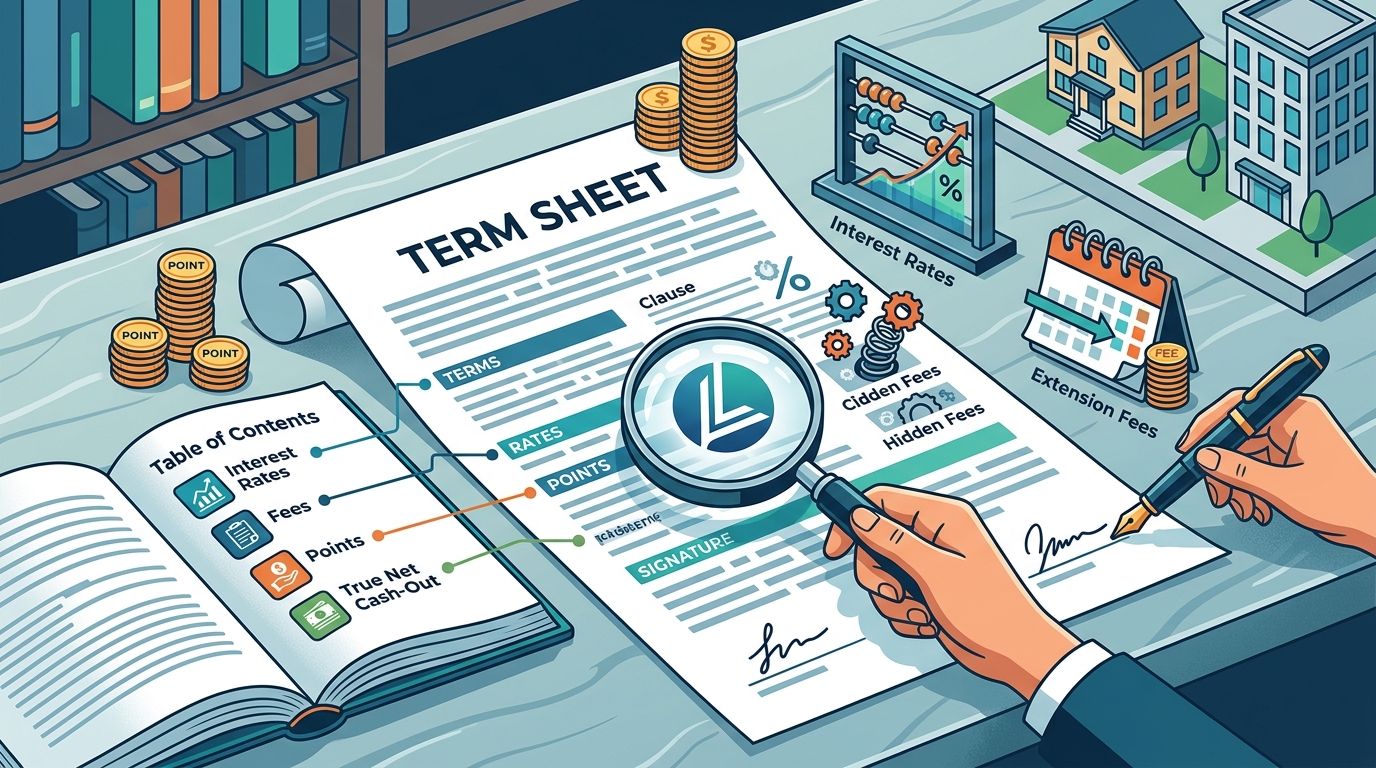
Before signing a hard money loan term sheet, you must verify the total cost of capital, including interest rates, origination points, and hidden extension fees. Lendersa provides an AI-powered comparison tool that standardizes these documents, allowing you to see the true net cash-out and avoid predatory clauses that traditional brokers often miss.
The Anatomy of a Hard Money Term Sheet
A hard money loan term sheet is a non-binding document that outlines the primary financial terms of a real estate loan. It serves as the blueprint for the final loan agreement. Understanding its core components is the first step in protecting your investment.
The most critical element is the Loan-to-Value (LTV) ratio. LTV is the ratio between the loan amount and the property value. Most hard money lenders lend up to 65% LTV, though some may go higher for fix-and-flip projects. You must ensure the LTV in the term sheet matches the appraisal value you expect. If the lender uses a lower value, your loan amount will decrease, or your required equity will increase.
Another key component is the interest rate structure. Hard money rates are typically higher than conventional loans, often ranging from 8% to 15%. You need to determine if the rate is simple or compound. Simple interest is calculated only on the principal, while compound interest accrues on unpaid interest. This distinction can significantly impact your total cost if the loan extends beyond the initial term.
Hidden Fees and the True Cost of Capital
Many borrowers focus solely on the interest rate, ignoring the fees that inflate the total cost. Origination points are upfront fees charged by the lender, usually between 2% and 10% of the loan amount. These points are often non-negotiable but should be clearly itemized in the term sheet.
Extension fees are a common trap. If your project takes longer than expected, you may need to extend the loan. Term sheets often include automatic extension fees, which can be 1% to 2% of the loan amount per month. Lendersa’s LoanCompare tool uses AI to read the fine print of any loan offer. It flags these non-obvious traps, such as predatory default interest rates and late fee structures, ensuring you see the full picture before committing.
Prepayment Penalties and Exit Strategies
Your exit strategy dictates how you will pay off the loan. Prepayment penalties are fees charged if you pay off the loan early. Some lenders impose a penalty for the first 6 to 12 months, while others allow prepayment without penalty. You must align the loan term with your project timeline to avoid these fees.
For fix-and-flip investors, the ability to prepay without penalty is crucial. If you sell the property quickly, a prepayment penalty can eat into your profit. Lendersa allows you to filter lenders based on prepayment terms. You can specify your maximum acceptable prepayment penalty length, ensuring you only see offers that fit your exit strategy.
Comparing Offers with AI Precision
Comparing term sheets from different lenders is difficult because they use different formats and jargon. One lender might quote a lower interest rate but hide massive processing fees on page 4 of their Letter of Intent. Lendersa’s proprietary AI tools destroy this information asymmetry. The platform standardizes all offers into a single, comparable format.
You can upload any loan estimate, LOI, or term sheet in any format, including PDFs or screenshots. Lendersa’s AI instantly transforms this static document into structured data. It then performs an apples-to-apples analysis, comparing the true cost of each loan. This allows you to negotiate with confidence, knowing exactly where you stand in the market.
Key Takeaways
- Always verify the LTV ratio against an independent appraisal to ensure the loan amount is accurate.
- Check if the interest rate is simple or compound, as this affects the total cost significantly.
- Itemize all fees, including origination points, extension fees, and processing charges.
- Review prepayment penalties to ensure they align with your project timeline and exit strategy.
- Use AI-powered tools like Lendersa’s LoanCompare to standardize and compare offers from multiple lenders.
- Look for hidden traps like default interest rates and assumption restrictions in the fine print.
Frequently Asked Questions
What is the difference between a term sheet and a loan agreement?
Are hard money loan term sheets binding?
No, hard money loan term sheets are generally non-binding. They outline the lender’s willingness to lend under specific conditions. However, the terms in the term sheet are usually carried over to the final loan agreement, so you should review them carefully.
How do I compare hard money loan rates without a credit pull?
You can use platforms like Lendersa that allow you to compare loan offers based on asset metrics rather than personal credit. Lendersa’s AI tools analyze the property and loan scenario, providing rate comparisons without requiring a hard credit inquiry or your Social Security Number.
What are extension fees in a hard money loan?
Extension fees are charges applied when you extend the loan term beyond the initial period. They are typically calculated as a percentage of the loan amount per month. These fees can add up quickly if your project is delayed.
Can I negotiate the terms in a hard money loan term sheet?
Yes, you can negotiate terms such as interest rates, points, and prepayment penalties. However, some lenders have rigid guidelines. Using a platform like Lendersa allows you to shop your deal to multiple lenders, increasing your leverage to negotiate better terms.
What is the typical LTV for a hard money loan?
The typical LTV for a hard money loan is 65%. Some lenders may go up to 75% or even 80% for fix-and-flip projects, depending on the property’s after-repair value and the borrower’s experience.
How does Lendersa help with term sheet comparison?
Lendersa uses AI to ingest and standardize term sheets from various lenders. It extracts key data points like rates, fees, and terms, allowing you to compare them side-by-side in a single dashboard. This eliminates the need to manually parse complex documents.