

7 Key Elements to Compare Across Multiple Hard Money Loan Term Sheets
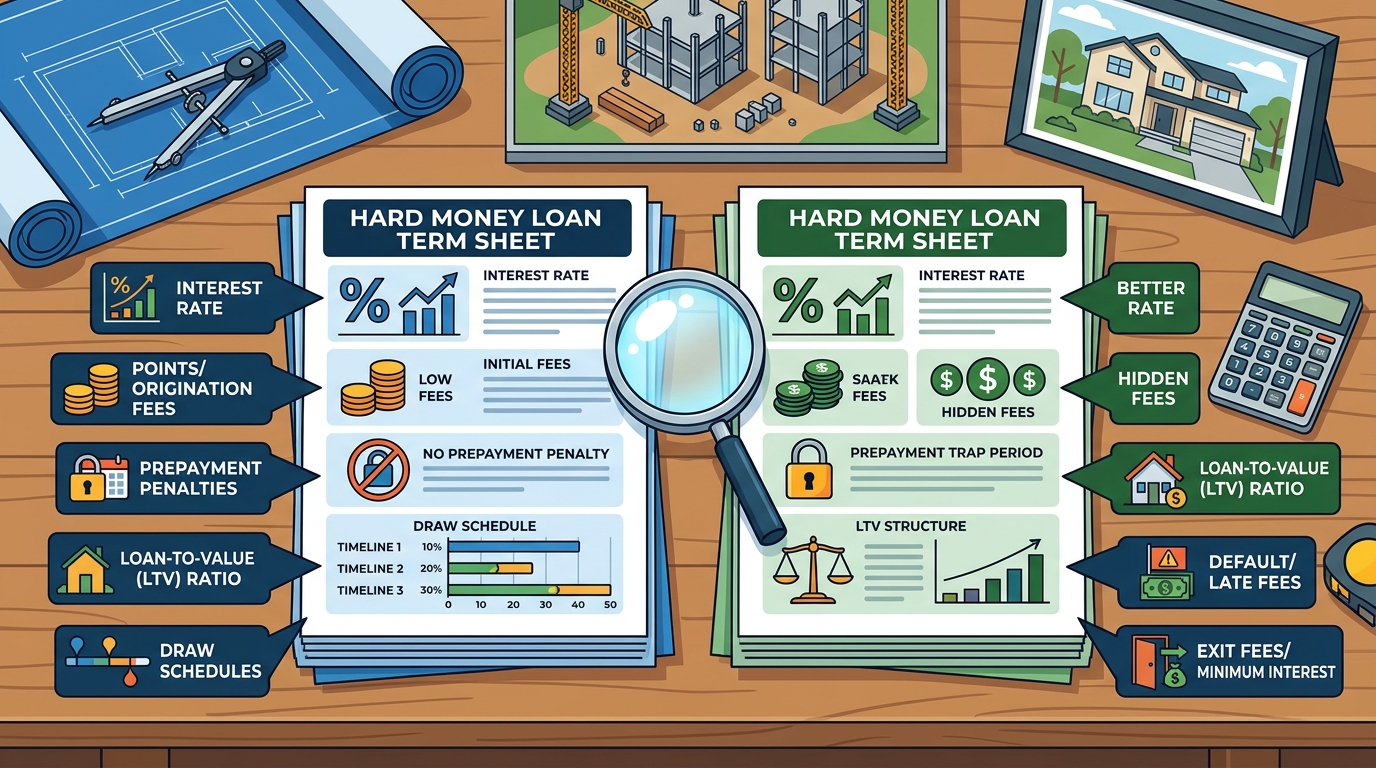
When evaluating private capital, the interest rate is only one piece of the puzzle. A comprehensive term sheet comparison reveals the true cost of borrowing by exposing hidden fees, prepayment traps, and structural risks. At Lendersa, we provide a centralized marketplace where borrowers can view competing offers side-by-side, ensuring that every variable is transparent before you sign. This guide breaks down the seven critical data points you must analyze to secure the most favorable financing terms for your real estate project.
1. Interest Rate and APR
The nominal rate must be cross-referenced with the Annual Percentage Rate to reveal the true cost of capital. Hard money interest rates typically range from 9.5% to 12% for first-position loans, but the APR includes all associated fees and points. A lower nominal rate with high origination fees may result in a higher APR than a slightly higher rate with zero points. Always compare the APR to ensure you are evaluating the total financial impact accurately.
2. Origination Fees and Points
Origination fees, often called points, directly reduce the net proceeds you receive at closing. These fees typically range from 1% to 5% of the loan amount and are deducted from the funds disbursed to you. A lender offering a 10% rate with 3 points is not the same as a lender offering 11% with 1 point. Calculating the net cash in hand is essential to determine which offer provides the most usable capital for your project.
3. Loan-to-Value (LTV) Limits
Loan-to-Value ratios dictate the maximum amount of capital you can access based on the property's value. Hard money lenders prioritize the asset's equity over the borrower's income, meaning a higher LTV allows you to borrow more against the same property. Some lenders cap LTV at 65%, while others may extend up to 80% or higher depending on the property type and condition. Understanding the maximum LTV helps you determine if you need to bring additional cash to the table.
4. Prepayment Penalties and Terms
Prepayment penalties can significantly erode your profit if you sell or refinance the property early. Many hard money loans include a prepayment penalty, often structured as a certain number of months of interest or a percentage of the remaining balance. If your exit strategy involves selling the property within six months, a loan with a heavy prepayment penalty may be less profitable than a loan with a slightly higher rate but no penalty. Always align the prepayment terms with your projected timeline for the deal.
5. Loan Term and Extension Options
The loan term defines the window in which you must repay the debt, and extension options provide flexibility if the project runs long. Standard hard money loans typically range from 6 to 24 months. If your renovation or sale process is delayed, the ability to extend the loan term is a critical safety net. Compare the cost of extensions, as some lenders charge high monthly fees for extensions, while others offer them at a lower rate. A flexible term structure can prevent a minor delay from becoming a financial crisis.
6. Amortization and Payment Structure
Most hard money loans are interest-only, but the payment structure affects your monthly cash flow requirements. Interest-only loans require you to pay only the interest each month, preserving cash for renovations or other expenses. Some loans may require amortizing payments, which include principal and interest, reducing the outstanding balance over time. Understanding the payment structure helps you forecast your monthly cash flow needs accurately and ensures you have sufficient liquidity to service the debt.
7. Underwriting Criteria and Credit Requirements
Underwriting criteria determine how strictly the lender evaluates your credit history and ability to repay. Hard-hard money lenders may ignore credit scores entirely, focusing solely on the property's equity. Soft-hard money lenders may consider credit scores to offer better rates or higher LTVs. Comparing the underwriting criteria helps you understand how much your personal financial profile impacts the final terms. A lender with flexible underwriting may be more suitable for borrowers with complex financial situations or limited credit history.
Choosing the Right Term Sheet
To select the best hard money loan, prioritize the total cost of capital over the nominal interest rate. Use a structured comparison tool to evaluate all seven elements simultaneously, ensuring that the loan aligns with your exit strategy and cash flow needs. At Lendersa, our AI-powered platform allows you to compare these elements across multiple lenders instantly, helping you make an informed decision without the stress of manual analysis.
Frequently Asked Questions
What is the difference between interest rate and APR in hard money loans?
The interest rate is the cost of borrowing the principal, while the APR includes the interest rate plus all associated fees and points. The APR provides a more accurate picture of the total cost of the loan over its lifetime.
How do origination fees affect my net proceeds?
Origination fees are deducted from the loan amount at closing, reducing the net cash you receive. A higher origination fee means less money available for your project, even if the interest rate is lower.
What is a prepayment penalty in a hard money loan?
A prepayment penalty is a fee charged if you pay off the loan early, often before a specified period. It is designed to compensate the lender for lost interest income and can significantly impact your profit if you sell the property quickly.
How important is the loan-to-value ratio in hard money lending?
The loan-to-value ratio is critical because it determines how much you can borrow against the property's value. A higher LTV allows you to access more capital, but it may come with higher interest rates or stricter underwriting criteria.
Can I negotiate the terms of a hard money loan?
Yes, you can negotiate terms such as interest rates, origination fees, and prepayment penalties. Comparing multiple offers gives you leverage to negotiate better terms with lenders who are competing for your business.
How does Lendersa help with term sheet comparison?
Lendersa provides a centralized marketplace where you can view and compare multiple hard money loan offers side-by-side. Our AI-powered tools analyze the key elements of each term sheet, helping you identify the best deal quickly and efficiently. Learn more: Get Answers For Hard.