

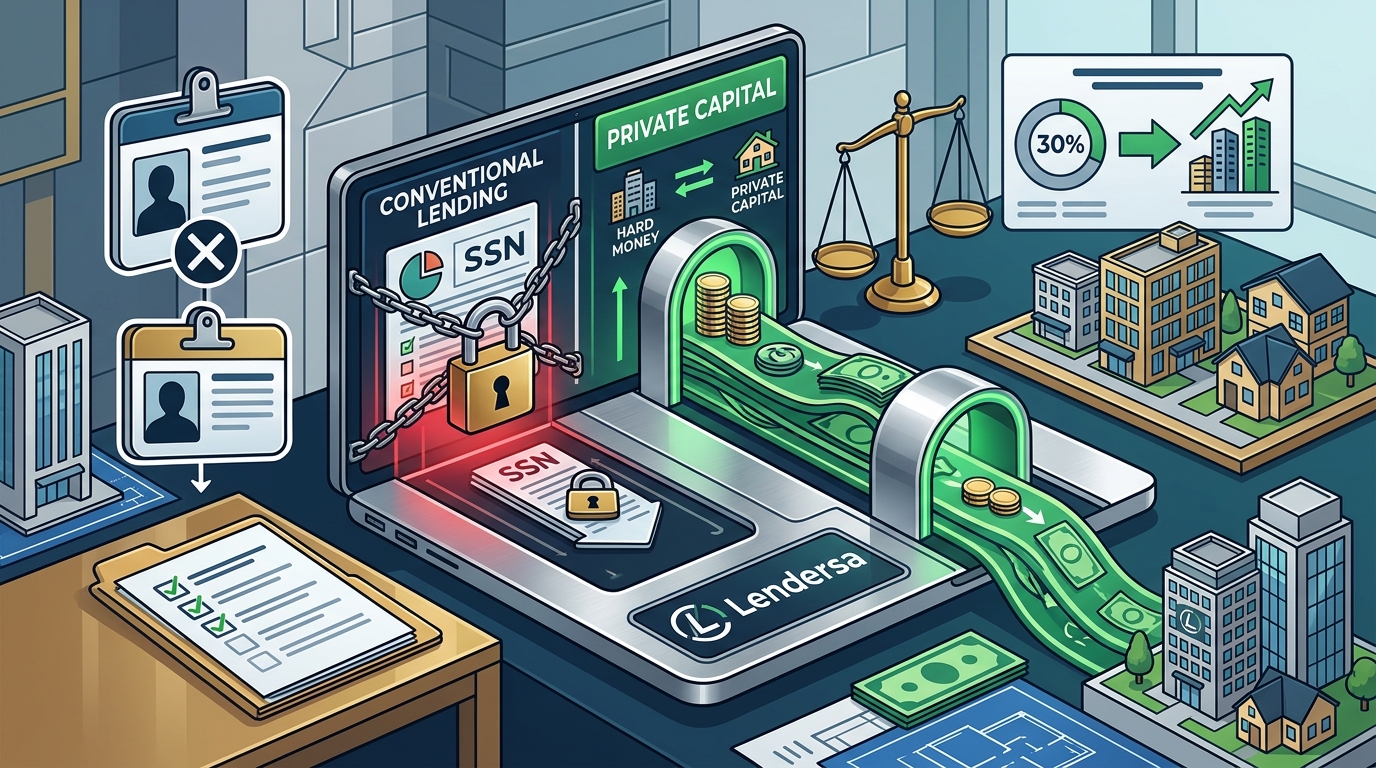
Yes. You can use Lendersa to begin comparing real estate financing options without entering a Social Security Number during the initial loan-search process. Instead of starting with a hard credit inquiry, the platform evaluates information about your property, requested loan amount, equity, financing purpose, and preferred loan structure to identify potentially suitable lenders. Initial results are designed to help you understand the market before you decide which lender, if any, should receive additional personal information.
This approach can be useful for real estate investors, foreign nationals, self-employed borrowers, developers, business owners, and anyone who wants to compare financing privately before moving into formal underwriting. Lendersa is a loan marketplace—not the lender providing the funds—and its AI-powered system connects loan scenarios with participating banks, private lenders, hard money lenders, mortgage brokers, and other financing sources. ([lendersa.com](https://www.lendersa.com/?utm_source=openai))
Key Takeaways
- An SSN is not required to start comparing: Lendersa states that borrowers can submit an initial loan request and view potential offers without providing a Social Security Number.
- Initial matching focuses on the deal: Property type, location, value, loan amount, loan-to-value ratio, use of funds, and exit strategy help determine which programs may fit.
- No hard inquiry during the initial search: Lendersa says that submitting an initial scenario does not trigger a hard pull on the borrower’s credit report. ([lendersa.com](https://www.lendersa.com/?utm_source=openai))
- Formal approval is different from market research: A lender may later request identity, income, tax, asset, credit, entity, appraisal, and compliance documents before issuing final approval or funding.
- You remain in control of lender contact: Lendersa says contact information is kept private until the borrower chooses to proceed with a specific lender.
- Available scenarios include multiple property categories: The platform supports residential, commercial, and vacant land financing, along with structures such as bridge, hard money, construction, fix-and-flip, blanket, reverse, interest-only, and fully amortizing loans. ([lendersa.com](https://www.lendersa.com/?utm_source=openai))
Short Answer: Yes, but Only for the Initial Comparison Stage
The important distinction is between comparing financing and completing a lender’s full application. Lendersa allows borrowers to begin with a property and loan scenario rather than an SSN. This lets the platform search its lender marketplace and identify possible matches without requiring the borrower to reveal the most sensitive identifier at the beginning.
That does not mean every lender will approve or fund a loan without eventually verifying the borrower’s identity. Once you select a lender or move toward a formal application, the lender may request an SSN, ITIN, passport, business documents, credit authorization, tax forms, bank statements, or other records required for underwriting and regulatory compliance. The SSN-free feature is therefore best understood as a private discovery and comparison tool, not a guarantee that an SSN will never be needed anywhere in the transaction.
Why Borrowers May Want to Shop Before Providing an SSN
Many borrowers hesitate to submit their SSN to multiple lenders because they are concerned about privacy, unwanted solicitations, identity theft, or unnecessary credit inquiries. A marketplace that begins with deal information can help separate early-stage research from formal underwriting.
For example, an investor evaluating a $450,000 property may want to compare a bridge loan, a rental-focused debt-service-coverage-ratio loan, and a conventional investment mortgage. At the research stage, the investor can focus on the financing variables that affect the deal—maximum leverage, interest rate structure, points, prepayment terms, reserves, closing timeline, and documentation—before deciding which lender deserves a complete application package.
Consumers should still use caution with any loan-related website or unsolicited offer. The Federal Trade Commission warns that unexpected loan messages and requests for sensitive information can be signs of phishing or identity-theft schemes. Do not click suspicious links, reply to unexpected loan texts, or provide an SSN or bank-account information to an unverified contact. ([consumer.ftc.gov](https://consumer.ftc.gov/consumer-alerts/2026/01/can-you-spot-fake-loan-text-scam?utm_source=openai))
How Lendersa Compares Loans Without an SSN
Lendersa describes its process as a four-stage AI marketplace workflow. The system uses the details of the proposed transaction to search lender guidelines and identify programs that may be appropriate for the scenario.
- Describe the transaction: Enter the property category, location, estimated value, purchase price, requested loan amount, purpose of financing, repair or construction budget, and intended exit strategy.
- Search for potential matches: The AI compares the scenario against lender criteria, including programs for residential, commercial, and vacant land transactions.
- Compare possible terms: Review available rate structures, leverage, loan term, estimated points, closing speed, repayment requirements, and other material conditions.
- Choose whether to proceed: Select the lender or financing path that appears most appropriate, then provide additional documentation directly as the transaction advances.
Lendersa says its platform can match scenarios with hundreds of lenders and may return several competing programs depending on the property, loan size, location, leverage, credit profile, and complexity of the request. The number of responses is not guaranteed; a highly specialized transaction may produce fewer matches than a standard investment property request. ([lendersa.com](https://www.lendersa.com/?utm_source=openai))
What Information Can You Provide Instead of an SSN?
An initial comparison generally works best when the scenario contains enough deal-level information for lenders to evaluate its basic structure. Depending on the property and loan type, prepare the following:
- Property details: Address or market, property type, unit count, zoning, occupancy, and current or planned use.
- Transaction details: Purchase price, estimated value, requested loan amount, down payment, refinance balance, and closing deadline.
- Collateral information: Current condition, renovation scope, projected after-repair value, appraisal information, and existing liens.
- Income or repayment information: Rental income, projected cash flow, debt-service-coverage ratio, business revenue, or the planned sale or refinance strategy.
- Borrower profile: Estimated credit range, investing experience, citizenship or residency status, entity ownership, and available liquidity when relevant.
- Loan preferences: Fixed or variable rate, interest-only or amortizing payments, bridge financing, construction financing, long-term rental financing, or other requested structure.
Providing accurate information improves the quality of the initial comparison. A quote based on incomplete or optimistic assumptions may change after appraisal, title review, borrower verification, income analysis, or final underwriting.
Who May Benefit From an SSN-Free Initial Comparison?
Foreign nationals and international investors
Borrowers who do not have a U.S. Social Security Number may still be able to explore private, hard money, commercial, or non-qualified mortgage programs. Depending on the lender, alternative documentation may include a passport, ITIN, foreign bank statements, proof of assets, entity records, and property-specific information. Acceptance is determined by the individual lender, not guaranteed by the marketplace.
Real estate investors
Investors often compare financing based on leverage, property value, projected resale value, rental cash flow, and closing speed. An initial deal-based search can be more useful than applying separately to several lenders before knowing which programs fit the transaction.
Self-employed borrowers and business owners
Traditional programs may rely heavily on tax returns and standardized income documentation. Private and non-QM lenders may consider broader evidence, such as bank statements, business cash flow, assets, or property performance, although documentation and pricing can vary significantly.
Borrowers protecting their privacy
Someone who is still evaluating a purchase, refinance, land acquisition, or construction project may prefer to avoid distributing an SSN until a lender has demonstrated that its terms and process are worth pursuing.
Loan Types You Can Explore
| Financing category | Common underwriting emphasis | Potential use cases | What to compare |
|---|---|---|---|
| Hard money | Collateral value, leverage, property condition, and exit strategy | Fix-and-flips, bridge loans, auctions, urgent acquisitions, and distressed properties | Interest rate, points, maximum loan-to-value, extension fees, draw procedures, and maturity date |
| Private money | Asset strength, transaction structure, sponsor experience, and relationship factors | Commercial purchases, land, bridge financing, and buy-and-hold investments | Recourse, repayment flexibility, collateral requirements, closing costs, and lender discretion |
| Non-QM | Alternative income documentation, property cash flow, assets, and borrower profile | Self-employed borrowers, foreign nationals, investors, and borrowers outside standard agency guidelines | Documentation rules, reserves, prepayment penalties, rate adjustments, and amortization |
| Conventional | Credit history, verified income, debt-to-income ratio, assets, and property eligibility | Primary residences and qualifying long-term investment properties | Annual percentage rate, mortgage insurance, underwriting conditions, timeline, and total cash to close |
Loan categories overlap in practice. A lender may offer more than one structure, and the lowest advertised rate may not be the least expensive option after points, fees, reserves, required repairs, prepayment penalties, and other conditions are included.
Example: Comparing a Fix-and-Flip Scenario
Assume an investor is purchasing a single-family property for $300,000 and expects to spend $75,000 on renovations. The projected after-repair value is $475,000, and the investor wants to close within two weeks.
Rather than submitting an SSN to several lenders immediately, the investor can begin by entering the property and transaction details. Potential lenders may evaluate the relationship between the purchase price, renovation budget, projected value, requested loan amount, and resale strategy. The investor can then compare:
- Whether renovation funds are included in the loan or funded through draws.
- Maximum leverage based on purchase price, total project cost, or after-repair value.
- Interest-only payment requirements and whether interest is charged on the full commitment or drawn balance.
- Origination points, appraisal fees, inspection charges, extension fees, and legal costs.
- Required reserves and minimum borrower liquidity.
- Expected closing timeline and conditions for issuing a formal letter of intent.
The initial comparison does not replace appraisal, title, insurance, environmental, credit, identity, or legal review. It helps the investor identify which proposals are worth pursuing before committing to a full lender process.
Privacy and Credit-Pull Considerations
Lendersa states that borrowers do not need to provide an SSN to view initial loan offers and that submitting an initial scenario does not create a hard inquiry. Its website also states that borrower contact information remains private until the borrower elects to move forward and that the platform includes tools for screening communications with interested lenders. ([lendersa.com](https://www.lendersa.com/?utm_source=openai))
Even when a platform does not require an SSN at the start, read every consent screen and privacy notice carefully. Before sending documents, confirm who will receive them, whether the communication is taking place through the marketplace or directly with a lender, what information is required, and whether the lender is properly licensed or otherwise authorized for the relevant transaction and jurisdiction.
What Happens After You Identify a Promising Loan?
Once you find a potentially suitable program, expect the process to become more detailed. The selected lender may request:
- Government-issued identification, such as a passport or driver’s license.
- SSN or ITIN information for identity, credit, tax, or compliance purposes.
- Purchase contract, settlement statement, title information, and entity documents.
- Income records, bank statements, rental schedules, or business financial statements.
- Appraisal, broker price opinion, inspection, environmental report, or construction budget.
- Insurance evidence, property taxes, leases, operating statements, and permits.
- A detailed explanation of the repayment plan, such as sale, refinance, rental cash flow, or another source of repayment.
At this stage, the lender—not Lendersa—makes the credit decision and sets the final terms. Initial estimates are not commitments to lend, and a term sheet or letter of intent may still include conditions that must be satisfied before closing.
Checklist for Comparing Offers Safely
- Confirm the lender’s identity: Research the company, licensing information, office location, and contact details independently.
- Compare total cost: Look beyond the interest rate and calculate points, lender fees, broker fees, servicing charges, legal costs, appraisal expenses, and other closing charges.
- Review leverage carefully: Understand whether the loan-to-value calculation uses current value, purchase price, total project cost, or after-repair value.
- Ask how payments work: Confirm whether payments are interest-only, fully amortizing, deferred, or based on outstanding principal.
- Check the maturity date: A short-term loan may require a refinance or sale sooner than expected.
- Understand extension and default provisions: Review extension fees, default interest, late charges, protective advances, and remedies.
- Do not pay suspicious advance fees: Be cautious if someone guarantees approval or demands money or sensitive information before providing verifiable loan details. The FTC identifies advance-fee loan scams as a common warning sign. ([consumer.ftc.gov](https://consumer.ftc.gov/articles/refund-and-recovery-scams?utm_source=openai))
- Use professional advice when appropriate: A real estate attorney, accountant, mortgage professional, or financial adviser can help evaluate legal, tax, and economic consequences.
Frequently Asked Questions
Can I compare loans on Lendersa without entering my Social Security Number?
Yes. Lendersa says borrowers can begin an initial loan request and view potential financing options without providing an SSN. The comparison uses property and transaction details to identify possible lender matches. A selected lender may request an SSN or other identifying information later during formal underwriting. ([lendersa.com](https://www.lendersa.com/?utm_source=openai))
Will starting a Lendersa loan request affect my credit score?
Lendersa states that the initial loan request does not trigger a hard credit inquiry. Because lender procedures can differ after you select a financing source, ask whether any later review will be a soft inquiry or hard inquiry before authorizing a credit check.
Can foreign nationals compare real estate financing without an SSN?
They may be able to explore potential programs without an SSN, particularly for asset-focused, private, hard money, commercial, land, or non-QM financing. The lender may later require a passport, ITIN, proof of assets, entity documents, tax information, or other records. Eligibility depends on the specific lender, property, location, leverage, and transaction structure.
Does no SSN required mean no documentation is needed?
No. It means the initial marketplace search can begin without that identifier. Final approval generally requires documentation to verify identity, collateral, ownership, income or assets, title, insurance, repayment capacity, and compliance requirements.
What properties can I compare financing for?
Lendersa supports financing searches for residential property, commercial property, and vacant land. The platform also describes programs for bridge financing, construction, fix-and-flip projects, rental properties, and other real estate scenarios. Available programs depend on the property and lender criteria.
How many lender responses will I receive?
There is no guaranteed number. Lendersa says the AI may identify approximately four to ten matching programs in typical cases, while complex scenarios may receive more or fewer responses. Location, loan size, leverage, credit profile, property type, and documentation all influence results. ([lendersa.com](https://www.lendersa.com/?utm_source=openai))
Is Lendersa the lender?
No. Lendersa describes itself as a loan-matching marketplace rather than the direct source of loan funds. Participating lenders make their own underwriting decisions, issue their own terms, and fund or arrange loans according to their agreements and applicable requirements. ([lendersa.com](https://www.lendersa.com/?utm_source=openai))
What should I do if I receive an unexpected loan message asking for my SSN?
Do not reply, click links, or provide sensitive information until you independently verify the sender. The FTC advises consumers to be cautious with unexpected loan texts and calls, especially when the contact requests an SSN, bank-account number, upfront payment, or immediate action. ([consumer.ftc.gov](https://consumer.ftc.gov/consumer-alerts/2026/01/can-you-spot-fake-loan-text-scam?utm_source=openai))
Start Comparing Real Estate Financing Without an SSN
You do not have to distribute your Social Security Number to every lender simply to learn what financing may be available. Begin with the property and deal information, compare potential hard money, private, conventional, commercial, residential, and vacant land options, and decide which lender merits a formal application.
Start your loan comparison on Lendersa to explore potential financing without an SSN at the initial stage. If you need help understanding hard money or private financing, Get Answers For Hard money and private financing options from the Lendersa team.
Important: Initial comparisons, estimates, and marketplace matches are not loan approvals or commitments to lend. Final terms depend on the selected lender’s underwriting, documentation, property review, applicable law, and closing conditions.