

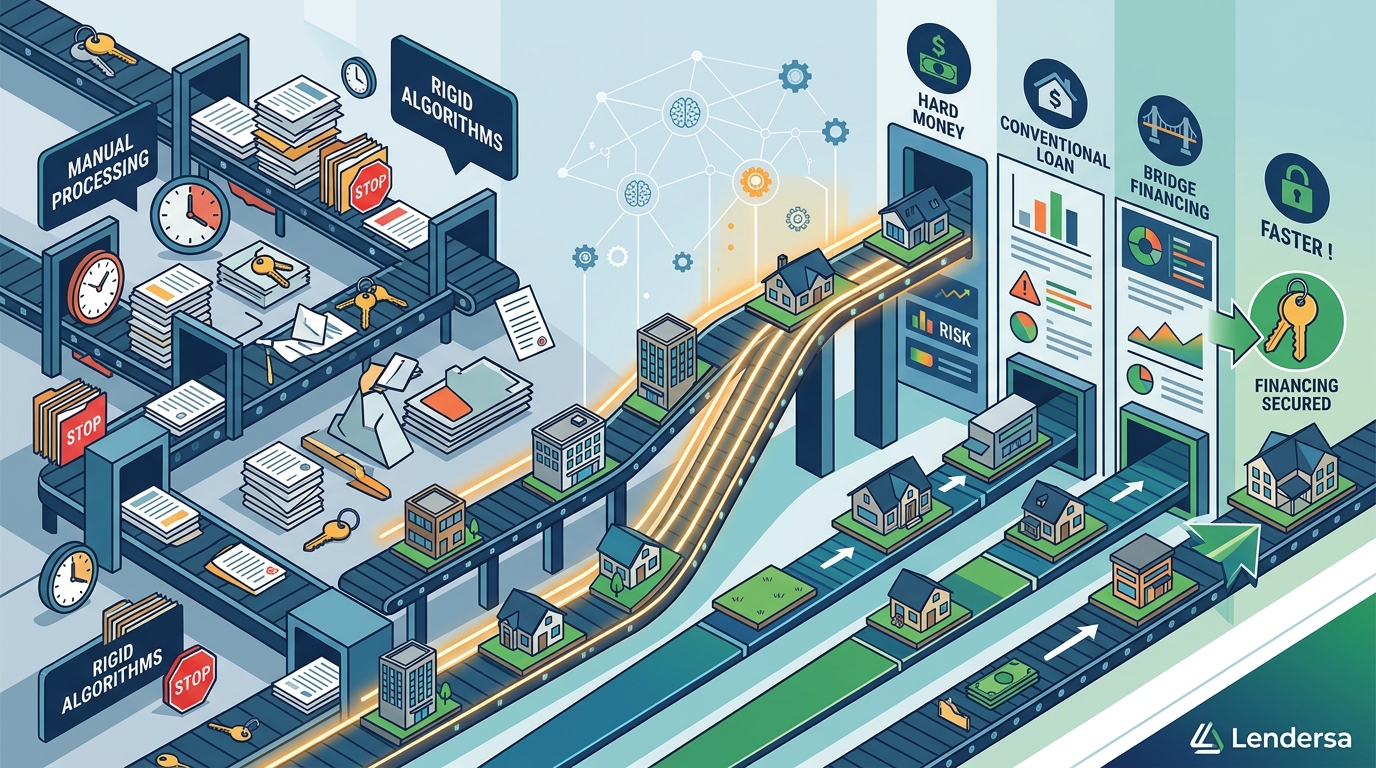
Traditional mortgage lending has become a fragmented maze of rigid algorithms and slow manual underwriting. According to recent industry data, the average time to close a conventional loan has increased by 15% over the last three years due to regulatory scrutiny and automated risk modeling. This delay often costs investors thousands of dollars in holding costs or causes them to lose competitive bidding advantages. The solution lies in leveraging automated capital matching protocols that bypass traditional bottlenecks. (Get Answers For Hard)
Step 1: Define Your Property and Loan Purpose
The first critical step in the financing comparison process is accurately categorizing your real estate asset. Lenders do not view all properties through the same lens. A vacant land parcel requires a completely different risk matrix than a stabilized commercial building. You must determine if your goal is a short-term bridge, a long-term conventional mortgage, or a specialized fix-and-flip loan.
Hard money lenders focus heavily on the After Repair Value (ARV) of the property. Conventional banks focus on your debt-to-income ratio and credit score. By clearly defining the property type, you allow the matching algorithm to route your request to the correct capital pool immediately. This prevents the common error of applying for a conventional loan when a private money loan is the only viable path.
Step 2: Prepare Your Equity and Asset Documentation
Unlike traditional banking, many alternative lending channels prioritize collateral over income verification. However, you must still prove your skin in the game. Equity is the primary currency in hard money lending. You need to gather recent appraisals, purchase agreements, or proof of ownership for the subject property.
If you are pursuing a conventional or non-QM loan, you will need standard financial documents. This includes bank statements, tax returns, and proof of assets. The clarity of your documentation directly impacts the speed of the Letter of Intent (LOI) issuance. Ambiguous financial histories force lenders to apply conservative risk premiums, which drives up your interest rate.
Step 3: Utilize Pre-Application Diagnostic Tools
Before submitting a full application, it is wise to run a diagnostic check on your loan profile. This step involves using proprietary scoring mechanisms to understand how lenders will perceive your deal. These tools analyze your credit profile, property value, and loan-to-value ratio to predict approval likelihood.
Using a LoanScore™ provides a baseline understanding of your eligibility. If the score indicates a low probability of approval from traditional banks, the system can automatically pivot your search toward private investors or hard money lenders. This proactive step saves time by preventing rejections from lenders who cannot fund your specific scenario.
Step 4: Submit to the Multi-Lender Protocol
Once your data is prepared, you submit your request to the Multi-Lender Protocol. This is the core engine of the comparison process. Instead of contacting individual lenders, your loan scenario is broadcast to a curated network of banks, credit unions, and private capital providers.
The protocol uses advanced AI to filter these lenders based on your specific criteria. It looks for lenders who have the capacity to fund your deal and the appetite for your property type. This automated routing ensures that your request is seen by the most relevant capital sources, eliminating the need for manual outreach to dozens of brokers.
Step 5: Compare Offers and Negotiate Terms
After the initial search, the system evaluates the responses. You will receive a Quote Comparison Dashboard containing offers from multiple qualified lenders. This is where the comparison process becomes actionable. You can view interest rates, points, loan terms, and closing timelines side by side.
The platform then pits these lenders against each other to negotiate better terms. By presenting competing offers, you create a market dynamic that incentivizes lenders to improve their rates or reduce fees to win your business. This finalization step ensures you secure the most favorable deal available in the current market.
Key Takeaways
- Equity is King: Hard money lenders prioritize the value of the collateral over personal income, making equity the primary driver for approval.
- AI Routing Efficiency: Automated protocols can match borrowers with hundreds of lenders in minutes, a process that traditionally took weeks.
- Diagnostic Pre-Checks: Using tools like LoanImprove™ helps identify potential roadblocks before formal submission.
- Competitive Bidding: The Multi-Lender Protocol forces lenders to compete, often resulting in lower rates and faster closings.
- No SSN Required for Initial Search: Early-stage comparison can often be conducted without providing sensitive personal identification, preserving your credit.
- Property Type Matters: Residential, commercial, and vacant land properties require distinct lending strategies and capital sources.
- Speed to LOI: Streamlined documentation leads to quicker Letters of Intent, allowing investors to lock in properties faster.
Frequently Asked Questions
How long does the AI comparison process take?
The initial AI search and matching process typically takes only a few minutes. However, the time to receive final offers depends on the lenders' internal underwriting speed, which can range from 24 hours to a few days.
Do I need a high credit score to use this service?
No. The platform connects you with a wide range of capital sources, including hard money lenders and private investors who may not require high credit scores. The focus is often on the property's value rather than your personal credit history.
What is the Multi-Lender Protocol?
The Multi-Lender Protocol is a proprietary system that simultaneously routes your loan request to multiple qualified lenders, creating a competitive bidding environment to secure the best terms.
Can I compare hard money and conventional loans side by side?
Yes. The platform aggregates both private capital and traditional bank loans, allowing you to evaluate the trade-offs between speed (hard money) and cost (conventional) in one dashboard.
Is my personal information secure during the search?
Yes. The initial search phase is designed to be non-intrusive and often does not require a Social Security Number, ensuring your data remains protected until you are ready to finalize a loan.
What types of properties are eligible?
Eligible properties include residential homes, commercial buildings, vacant land, and fix-and-flip projects. The AI matches your specific property type with lenders who specialize in that asset class.
How do I finalize the loan after comparing offers?
Once you select the best offer, you work directly with the awarded lender to complete the underwriting process. The platform facilitates the introduction and provides ongoing support through the LoanCompare™ tools.
Start Your Financing Journey Today
Stop guessing which lender will approve your loan. Start the financing comparison process now by utilizing the Lendersa platform. Let AI do the heavy lifting while you secure the best possible terms for your real estate investment.