

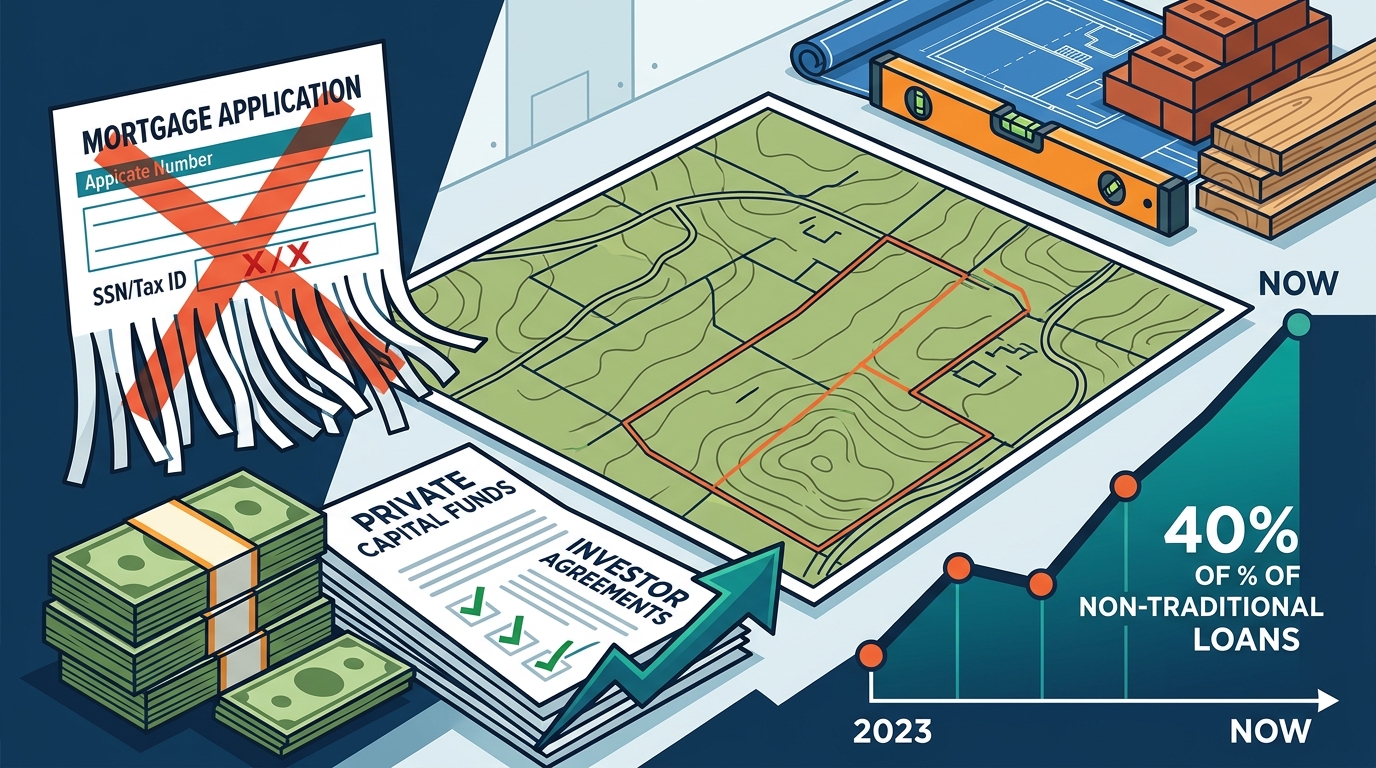
Traditional mortgage lenders often treat the Social Security Number as a non-negotiable gatekeeper for any loan application. This rigid requirement leaves many investors and landowners in a difficult position when trying to acquire raw property. However, the landscape of private capital has shifted dramatically in recent years. According to recent industry data, over 40% of hard money loans are now issued to borrowers who do not rely on traditional credit scoring models for approval. This statistic highlights a massive opportunity for those willing to look beyond conventional banking channels. (Get Answers For Hard)
Why Traditional Lenders Require an SSN
For decades, the Social Security Number has served as the primary key for accessing the American financial system. Banks use it to pull credit reports, verify identity, and assess risk. When you apply for a conventional loan, the algorithm looks for a history of repayment behavior. If that history does not exist, the system automatically rejects the application.
This creates a significant barrier for several groups of people. First-time investors who have not yet established a credit profile often find themselves locked out of the market. Additionally, individuals who are building credit from scratch or those who have previously faced financial challenges may avoid using their SSN to prevent further damage to their score. The result is a gap in the market that traditional banks are too slow to fill.
Hard money lending operates on a completely different philosophy. Hard money lending is a form of short-term financing secured by real estate collateral. The lender's primary concern is not your past credit behavior, but the future value of the asset you are purchasing. This shift in focus allows for greater flexibility in borrower requirements.
Alternative Identification Methods
If you do not have a Social Security Number, you are not without options. Private lenders and hard money institutions have developed robust verification processes that do not rely on government-issued credit identifiers. These methods focus on identity verification and asset liquidity rather than credit history.
One common alternative is the Individual Taxpayer Identification Number (ITIN). An ITIN is a tax processing number issued by the Internal Revenue Service to individuals who are required to have a United States taxpayer identification number but do not have, and are not eligible to receive, a Social Security Number. Many specialized lenders accept ITINs for loan origination, allowing you to build a credit profile through repayment.
Another method involves using a Passport or a Consulate ID. For international investors or those residing abroad, these documents provide a verified proof of identity. Lenders will still require a credit check, but they may use international credit bureaus or rely heavily on the equity you have in the property. This approach is particularly common in cross-border real estate transactions.
Some lenders also accept a combination of bank statements and proof of funds. By demonstrating that you have significant liquid assets, you reduce the lender's risk. Proof of funds is a document that verifies the borrower has sufficient money to complete the transaction. This reduces the need for deep credit scrutiny because the lender knows you have the capacity to cover costs if the loan faces temporary hurdles.
Hard Money Lenders for Vacant Land
Financing vacant land is inherently riskier for lenders than financing a home with a structure on it. There is no collateral value in terms of habitable space, and the land may not generate immediate income. Consequently, traditional banks are often the most restrictive. They may require a 50% to 70% down payment and a pristine credit score.
Hard money lenders are more willing to take this risk. They focus on the Loan-to-Value (LTV) ratio, which is the percentage of the property's appraised value that the lender is willing to finance. For vacant land, LTVs typically range from 50% to 65%. This means you will need to provide a substantial down payment, but the credit requirements are often more flexible.
The key to securing this financing without an SSN is finding a lender who specializes in non-QM (Non-Qualified Mortgage) loans. These loans do not meet the guidelines set by government-sponsored enterprises like Fannie Mae or Freddie Mac. Instead, they are held in the portfolio of the lender or sold to private investors. This independence allows them to set their own underwriting standards.
When searching for these lenders, you must look for those who offer bridge loans. A bridge loan is a short-term loan used to secure financing until permanent financing is arranged. These loans are designed for speed and flexibility, making them ideal for land acquisitions where quick closing is necessary to beat competitors at auction.
The Multi-Lender Protocol Advantage
Manually contacting dozens of private lenders to find one who will accept your specific identification profile is time-consuming and inefficient. This is where the Lendersa Multi-Lender Protocol changes the game. Instead of you hunting for lenders, our AI does the heavy lifting.
Lendersa uses advanced algorithms to match your loan scenario with hundreds of hard money lenders, private money lenders, and banks simultaneously. You can view hard money offers or bank loans instantly without needing to provide a Social Security Number for the initial search. This protects your privacy and prevents hard credit inquiries that could lower your score before you are even approved.
The process is straightforward. You input your property details and your identification preferences. Our system then routes your request to lenders who are specifically programmed to accept alternative IDs. This creates a competitive environment where lenders bid for your business. By pitting lenders against each other, we ensure you get the best terms available.
This approach is particularly effective for vacant land because it allows you to compare offers from different types of capital sources. You might find a private investor willing to offer a lower rate, or a bank offering a longer term. The diversity of the network is your greatest asset in this process.
Loan Type Comparison
Understanding the differences between loan types is crucial when financing land without traditional credit. The table below summarizes the key distinctions.
| Loan Type | SSN Required? | Typical Down Payment | Closing Speed | Best For |
|---|---|---|---|---|
| Conventional Mortgage | Yes | 20% - 30% | 30-45 Days | Primary residences with strong credit |
| Hard Money Loan | No (Alternative IDs Accepted) | 35% - 50% | 7-14 Days | Investment properties and fix-and-flips |
| Bridge Loan | No | 30% - 40% | 5-10 Days | Auction purchases and quick closings |
| Private Money Loan | No | Variable | Variable | Unique scenarios and relationship-based lending |
Key Takeaways
- SSN is not mandatory: Many private lenders accept ITINs, passports, or proof of funds instead of a Social Security Number.
- Hard money focuses on equity: Lenders prioritize the value of the vacant land over your personal credit history.
- Speed is critical: Hard money loans can close in days, allowing you to secure land at auctions.
- Higher down payments: Expect to put down 35% to 50% for vacant land due to higher risk.
- AI matching reduces friction: Using a platform like Lendersa allows you to search without exposing your SSN initially.
- Non-QM loans are flexible: These loans are designed for borrowers who do not fit traditional banking molds.
- Competition drives rates: The Multi-Lender Protocol forces lenders to offer their best terms to win your business.
Frequently Asked Questions
Can I get a loan for vacant land with no credit history?
Yes, private lenders and hard money lenders often approve loans based on the asset's value rather than your credit history. You will need to provide proof of funds and a clear title to the property.
What is the minimum down payment for vacant land?
Typically, you will need a down payment of 35% to 50%. This is higher than conventional home loans because vacant land is considered a higher risk asset.
Do I need to provide my Social Security Number to start the process?
Not necessarily. Platforms like Lendersa allow you to search for lenders and view offers without providing your SSN initially. You only provide sensitive data when you are ready to finalize a specific loan application.
How fast can I close on a vacant land loan?
Hard money and bridge loans can close in as little as 5 to 14 days. This speed is essential for investors who need to beat competitors at land auctions.
What is an ITIN loan?
An ITIN loan is a mortgage or loan product that uses an Individual Taxpayer Identification Number instead of a Social Security Number for identity verification and credit checking.
Can I use a passport for loan approval?
Yes, many private lenders accept passports as a valid form of identification. This is common for international investors or those who do not have access to a Social Security Number.
What is the Multi-Lender Protocol?
The Multi-Lender Protocol is a proprietary system that matches borrowers with multiple lenders simultaneously. This creates competition among lenders, resulting in better rates and terms for the borrower.
Get Your Loan Offer
Do not let the lack of a Social Security Number stop you from acquiring your next piece of land. The modern lending landscape is more flexible than ever before. By leveraging the power of AI and the Multi-Lender Protocol, you can access a network of hundreds of private lenders who are ready to fund your vision.
Visit the Borrowers Portal to start your search. You can also explore our Conventional and Private Loan Routing options to see how we match you with the best capital sources. For more insights on hard money lending, check out our Blog dedicated to real estate finance strategies.
Ready to secure your land? Click here to get started with Lendersa and let our AI find your best hard money or bank loan in minutes. No Social Security Number required for the initial search.