

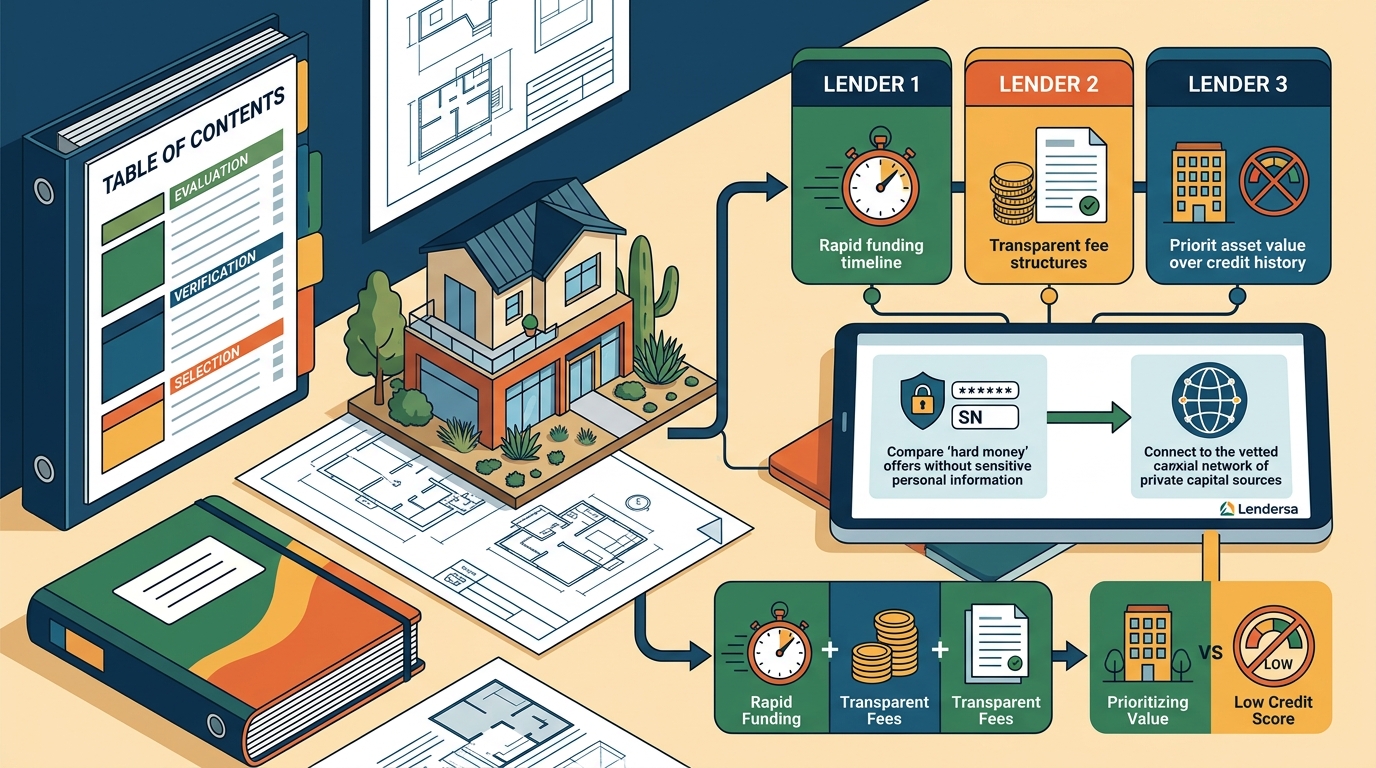
The best hard money lenders in California are those that prioritize asset value over credit scores, offer transparent fee structures, and provide rapid funding. Lendersa connects borrowers with a vetted network of private capital sources, allowing you to compare multiple offers without sharing your Social Security Number. This guide covers how to evaluate, verify, and select the right lender for your specific real estate project.
How to Choose a Lender
Selecting the right lender requires looking beyond the advertised interest rate. A hard money loan is a short-term financing instrument secured by real estate, where the lender's primary focus is the property's value rather than the borrower's income. In California, the market is fragmented, with thousands of private investors and funds operating under different guidelines.
Asset-Based Underwriting
Top-tier lenders evaluate the Loan-to-Value (LTV) ratio as the primary metric. LTV is the ratio of the loan amount to the appraised value of the property. Most California lenders lend up to 65% LTV, while some may go higher for fix-and-flip projects based on the After Repair Value (ARV). A good lender will clearly state their maximum LTV and how they calculate it.
Speed and Flexibility
Speed is a critical differentiator. Traditional banks often take 45 to 60 days to close a loan. Private hard money lenders can fund in as little as 7 to 14 days. When choosing a lender, ask about their average closing time and whether they have in-house appraisers or rely on third-party services. Lendersa's platform allows you to filter lenders by funding speed, ensuring you only see options that match your timeline.
Questions to Ask Before Committing
Before signing any term sheet, you must ask specific questions to uncover hidden costs and restrictions. The real estate lending industry has historically relied on information asymmetry, where the lender knows the math but the borrower does not.
Fee Transparency
Ask for a complete breakdown of all fees, including origination points, processing fees, and extension fees. Origination points are typically 2 to 5% of the loan amount. Some lenders charge "junk fees" for document preparation or wire transfers. A reputable lender will provide a clear Loan Estimate that itemizes every charge.
Prepayment Penalties
Ask if there is a prepayment penalty and how long it lasts. Many hard money loans have a prepayment penalty of 3 to 6 months. If you plan to sell the property quickly, a lender with a shorter or no prepayment penalty will save you significant money. Lendersa's LoanCompare tool can analyze term sheets to flag restrictive covenants and hidden fees automatically.
Verifying Credentials and Claims
Not all lenders are created equal. Some are licensed mortgage companies, while others are private individuals or unregulated funds. Verifying a lender's credentials is essential to protect your assets.
Licensing and Registration
Check if the lender is registered with the California Department of Business Oversight. While private money lenders may not always require a mortgage license, regulated entities must be. You can verify a lender's status through state regulatory databases. If a lender cannot provide proof of their business registration, proceed with caution.
Track Record
Ask for references from past borrowers. A legitimate lender will have a history of successful closings. Look for reviews and testimonials that mention the lender's communication style and adherence to timelines. Lendersa provides a directory of verified lenders, helping you filter out unvetted operators.
The Lending Process and Timeline
Understanding the workflow helps you prepare the necessary documents and manage expectations. The process typically involves five stages: application, underwriting, appraisal, term sheet, and closing.
Application and Underwriting
You submit a loan request with basic property details. The lender reviews the property's location, condition, and your proposed exit strategy. Unlike conventional loans, hard money underwriting does not require W-2s or extensive income verification. This stage usually takes 1 to 3 days.
Appraisal and Term Sheet
The lender orders an appraisal to determine the property's current value and ARV. Once the appraisal is complete, the lender issues a term sheet outlining the loan amount, interest rate, and fees. You review and negotiate the terms. This stage takes 3 to 7 days.
Closing and Funding
After accepting the term sheet, you sign the loan documents. The lender funds the loan, often within 24 to 48 hours of signing. The entire process can be completed in under two weeks.
Understanding the True Cost
Hard money loans are more expensive than conventional mortgages, but the cost is driven by specific factors. The total cost includes the interest rate, origination points, and any additional fees.
Interest Rates
Interest rates for hard money loans in California typically range from 8% to 15%. The rate depends on the LTV, the property's condition, and the lender's risk assessment. A lower LTV usually results in a lower interest rate.
Origination Points
Origination points are charged upfront and are usually 2 to 5% of the loan amount. For a $500,000 loan, 3 points would cost $15,000. This fee compensates the lender for the risk and administrative work involved in the loan.
| Factor | Conventional Loan | Hard Money Loan |
|---|---|---|
| Interest Rate | 5% - 8% | 8% - 15% |
| Origination Points | 0 - 2% | 2 - 5% |
| Closing Time | 45 - 60 days | 7 - 14 days |
| Credit Requirement | Good to Excellent | Any |
| Income Verification | Required | Minimal |
Common Mistakes to Avoid
Borrowers often make errors that lead to higher costs or denied loans. Avoiding these mistakes can save you thousands of dollars.
Ignoring the Exit Strategy
Lenders want to know how you plan to repay the loan. A clear exit strategy, such as selling the property or refinancing, is crucial. If your plan is vague, the lender may charge a higher rate or deny the loan.
Not Comparing Offers
Accepting the first offer you receive is a common mistake. Rates and fees vary significantly between lenders. Use a platform like Lendersa to compare multiple offers side-by-side. This ensures you get the best possible terms for your specific deal.
Hard Money vs. Conventional Loans
Choosing between hard money and conventional financing depends on your goals and timeline. Conventional loans are better for long-term ownership, while hard money loans are ideal for short-term projects.
When to Use Hard Money
Use hard money for fix-and-flip projects, distressed property purchases, or when you need fast funding. It is also a good option if you have poor credit or non-traditional income. The flexibility of hard money allows you to close deals that banks would reject.
When to Use Conventional
Use conventional loans for primary residences or long-term investments. The lower interest rates and longer terms make them more affordable over time. If you have good credit and stable income, a conventional loan is usually the better choice.
Situational Financing Strategies
Different real estate scenarios require different financing approaches. Tailoring your strategy to your specific situation can improve your odds of approval.
Fix-and-Flip
For fix-and-flip projects, lenders focus on the ARV. You need a detailed renovation budget and a timeline. Lendersa's LoanImprove tool can help you optimize your loan request to meet lender guidelines for fix-and-flip deals.
Commercial Real Estate
Commercial loans are more complex and often require higher down payments. Private lenders may offer more flexibility than banks for commercial properties, especially for niche assets like self-storage or medical offices.
Regulations and Borrower Protections
California has specific regulations governing real estate lending. Understanding these rules protects your rights as a borrower.
Truth in Lending Act
The Truth in Lending Act (TILA) requires lenders to disclose the total cost of the loan, including the Annual Percentage Rate (APR). This ensures transparency and allows you to compare offers accurately.
Anti-Predatory Lending Laws
California has laws designed to prevent predatory lending practices. These laws limit certain fees and require lenders to provide clear disclosures. If a lender refuses to provide a written Loan Estimate, it is a red flag.
California Market Specifics
California's real estate market has unique characteristics that affect hard money lending. High property values and strict regulations create a competitive landscape for lenders.
High-Cost Areas
In high-cost areas like Los Angeles and San Francisco, property values are significantly higher. This can affect the LTV calculation and the loan amount you can secure. Lenders in these areas may have higher minimum loan amounts.
Local Lenders vs. National
Local lenders often have better knowledge of specific neighborhoods and property values. They may be more willing to lend on properties in areas that national lenders avoid. However, national lenders may offer more competitive rates due to their larger capital pools.
The Impact of Timing
Timing is critical in real estate. Market conditions and interest rates can change rapidly, affecting your financing options.
Market Cycles
During a seller's market, competition for properties is high. Fast funding is essential to win bids. Hard money lenders can provide the speed you need to close quickly. In a buyer's market, you may have more time to negotiate terms, but interest rates may be lower.
Interest Rate Trends
Interest rates fluctuate based on economic conditions. If rates are rising, locking in a hard money loan quickly can save you money. Monitor rate trends and act when the timing is right.
Long-Term Outcomes
Hard money loans are short-term, but their impact on your long-term financial goals can be significant. Using them strategically can build your real estate portfolio.
Portfolio Growth
Many investors use hard money loans to acquire properties, renovate them, and then refinance into conventional loans. This strategy allows you to leverage your equity and grow your portfolio without tying up your own capital.
Credit Building
While hard money loans do not directly build credit, successfully managing them can improve your financial profile. A history of on-time payments and successful project completions can make you a more attractive borrower for future conventional loans.
Key Takeaways
- Hard money loans are secured by property value, not credit scores.
- Always compare multiple offers to get the best rate and fees.
- Verify the lender's credentials and track record before committing.
- Understand the total cost, including interest rates and origination points.
- Have a clear exit strategy to improve your odds of approval.
- Use platforms like Lendersa to streamline the comparison process.
- Be aware of California-specific regulations and market conditions.
- Timing is crucial; act quickly in competitive markets.
Frequently Asked Questions
What is the maximum LTV for hard money loans in California?
Most lenders offer up to 65% LTV, but some may go higher for fix-and-flip projects based on the After Repair Value.
How fast can a hard money loan be funded?
Funding can occur in as little as 7 to 14 days, depending on the lender and the complexity of the deal.
Do I need good credit to get a hard money loan?
No, hard money lenders focus on the property's value, not your credit score. Poor credit is rarely a barrier to approval.
What are the typical interest rates for hard money loans?
Interest rates typically range from 8% to 15%, depending on the LTV and the property's condition.
Can I use a hard money loan for a primary residence?
Yes, but it is usually more expensive than a conventional loan. It is best used for short-term needs or when you cannot qualify for a conventional loan.
How does Lendersa help me find a lender?
Lendersa connects you with a network of vetted lenders and allows you to compare offers without sharing your Social Security Number.
What is a prepayment penalty?
A prepayment penalty is a fee charged if you pay off the loan early. It is typically 3 to 6 months of interest.
Are hard money loans regulated in California?
Yes, they are subject to state and federal regulations, including the Truth in Lending Act and anti-predatory lending laws.
Conclusion
Choosing the best hard money lender in California requires careful evaluation of fees, speed, and lender credibility. By using a platform like Lendersa, you can compare multiple offers and find the right fit for your project. Start your search today to secure the financing you need.