

Securing capital for commercial real estate or undeveloped land is significantly more complex than financing a primary residence. According to recent industry data, over 60% of commercial loan applications face initial rejection due to strict debt-service coverage ratios and collateral requirements. This guide details the specific financing pathways available for these asset classes, leveraging advanced matching protocols to identify the most viable capital sources. (Get Answers For Hard)
Understanding Commercial Loan Structures
Commercial real estate financing differs fundamentally from residential lending. Lenders evaluate the income-generating potential of the property rather than just the borrower's personal credit score. Commercial loans are typically structured as non-recourse or limited-recourse debt, meaning the lender's claim is primarily against the asset itself. (About Lendersa 50 Years)
For investors, understanding the distinction between fixed-rate and adjustable-rate commercial mortgages is critical. Fixed rates offer stability for long-term holds, while adjustable rates may provide lower initial payments for shorter-term flips. The LoanCompare™ tool available on our platform helps borrowers visualize these cost differences instantly. (Loan Types In Los)
Key commercial loan types include:
- SBA 504 Loans: Ideal for owner-occupied commercial properties with favorable terms. (Compare Hard Money amp)
- Conventional Commercial Mortgages: Offered by major banks for properties with strong cash flow.
- Bridge Loans: Short-term financing used to secure properties before long-term funding is arranged.
Vacant Land Financing Types
Financing undeveloped land is notoriously difficult because the asset generates no immediate income. Lenders view raw land as high-risk collateral. However, several specific products exist to facilitate these purchases.
Land loans are specialized financing instruments designed exclusively for the purchase of undeveloped property. These loans often require higher down payments, typically ranging from 20% to 50%, compared to the 3% to 20% required for residential homes. Interest rates are also generally higher to compensate for the increased risk.
Types of vacant land financing include:
- Raw Land Loans: For unimproved land with no utilities or access. These carry the highest interest rates.
- Lot Loans: For subdivided lots within a developed community. These are easier to secure if infrastructure is already in place.
- Construction-to-Permanent Loans: Combines land acquisition and construction financing into one closing process.
Hard Money vs. Conventional Lending
Investors often debate between hard money lenders and conventional banks. The choice depends on speed, credit profile, and the condition of the property.
| Feature | Hard Money Loans | Conventional Loans |
|---|---|---|
| Speed of Funding | Days to weeks | 30 to 60 days |
| Credit Requirements | Flexible, asset-focused | Strict, score-focused |
| Down Payment | 20% to 35% | 15% to 25% |
| Interest Rates | Higher (8% to 15%+) | Lower (6% to 9%) |
| Best For | Fix-and-flip, auctions | Long-term holds |
Hard money loans are private loans secured by real property. They are often used by investors who need quick access to capital for fix-and-flip projects or auction purchases. Conventional loans, on the other hand, are backed by government-sponsored enterprises and offer lower rates for stable, income-producing assets.
The Multi-Lender Protocol Advantage
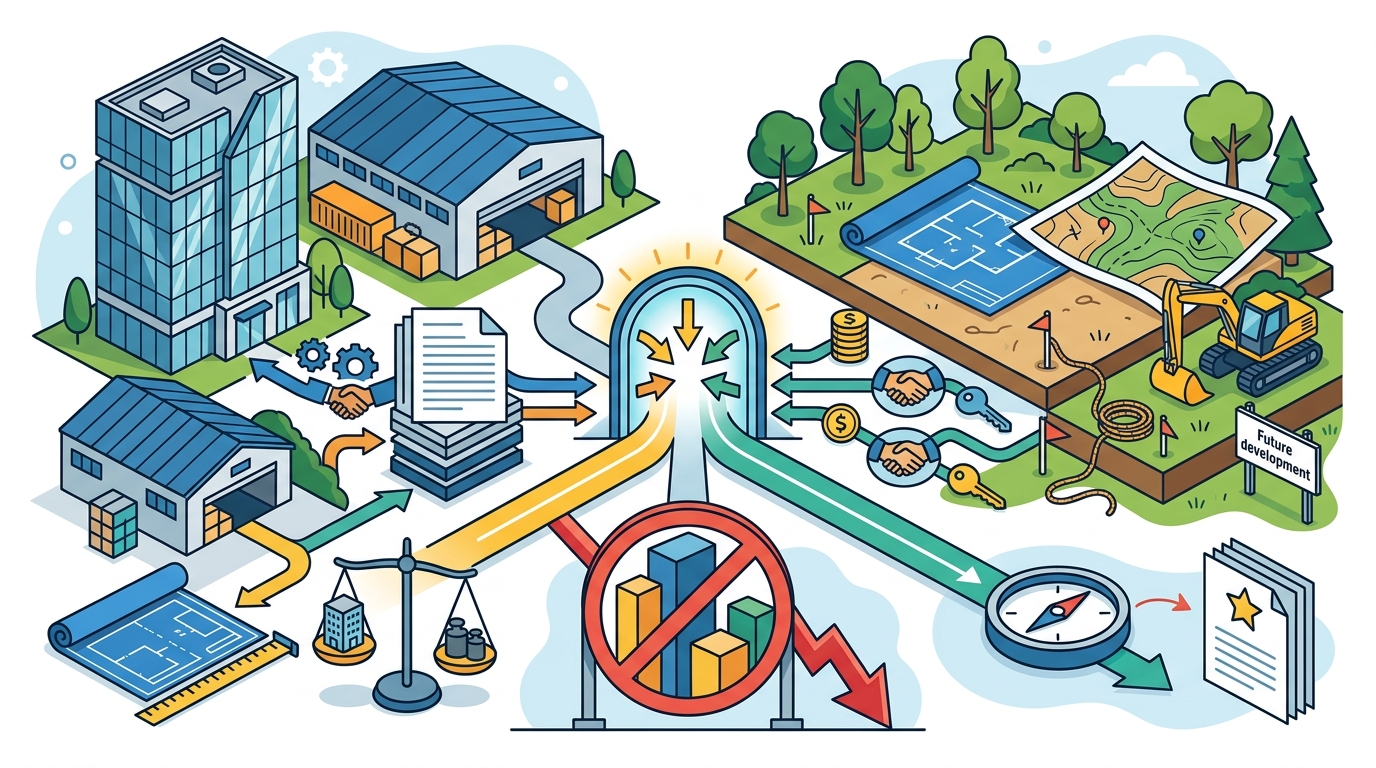
Traditional lending requires borrowers to contact multiple banks and private lenders individually. This process is time-consuming and often yields inconsistent quotes. The Lendersa Multi-Lender Protocol changes this dynamic by aggregating demand.
Our platform uses advanced AI to match your specific commercial or land loan scenario with hundreds of qualified lenders. This includes big banks, credit unions, private investors, and hard money brokers. By presenting your loan request to multiple qualified lenders simultaneously, we create a competitive environment that drives them to offer their best terms.
The process is streamlined into four steps:
- Search: AI identifies potential lenders based on your property type and loan purpose.
- Compare: Top matching programs are evaluated for rate, term, and fees.
- Negotiate: Lenders compete for your business, often resulting in lower rates or reduced fees.
- Finalize: The top lender is awarded the loan, with runners-up kept on standby.
This approach ensures you never miss out on better terms due to a lack of market visibility. You can view hard money offers or bank loans instantly without needing to provide a Social Security Number during the initial search phase.
Eligibility & Underwriting Criteria
Understanding what lenders look for is crucial for securing approval. Commercial and land loans are underwritten based on specific metrics that differ from residential standards.
Debt Service Coverage Ratio (DSCR) is a critical metric used by lenders to assess the cash flow of a property. It measures the property's net operating income against its debt obligations. A DSCR of 1.25 or higher is typically required for conventional commercial loans.
Other key eligibility factors include:
- Loan-to-Value (LTV) Ratio: Lenders typically finance 65% to 75% of the appraised value for commercial properties.
- Experience: Investors with a track record of successful projects often receive more favorable terms.
- Property Condition: For fix-and-flip loans, the after-repair value (ARV) is a primary driver of loan size.
If your credit profile is less than perfect, hard money lenders may still offer funding based on the equity in the property. Our LoanScore™ tool can help you understand your eligibility before applying.
Key Takeaways
- Commercial loans focus on property cash flow, not just personal credit.
- Vacant land loans require higher down payments, often 20% to 50%.
- Hard money offers speed but at a higher cost than conventional financing.
- The Multi-Lender Protocol allows lenders to compete for your business.
- DSCR is the primary metric for evaluating commercial property viability.
- Lendersa matches borrowers with hundreds of capital sources nationwide.
- Initial searches do not require a Social Security Number.
Frequently Asked Questions
What is the difference between a commercial loan and a conventional mortgage?
Commercial loans are secured by income-producing properties and are underwritten based on the property's cash flow. Conventional mortgages are for residential properties and are underwritten based on the borrower's personal income and credit.
Can I get financing for raw, unimproved land?
Yes, but it is more difficult. Raw land loans typically require larger down payments and higher interest rates because the land has no immediate utility or income generation.
How fast can I close on a hard money loan?
Hard money loans can close in as little as a few days to two weeks, depending on the lender's efficiency and the complexity of the property appraisal.
Do I need a high credit score for commercial real estate loans?
While a good credit score helps, commercial lenders prioritize the property's ability to generate income. Some private lenders may overlook lower credit scores if the equity position is strong.
What is the Multi-Lender Protocol?
It is a proprietary technology that simultaneously presents your loan request to multiple qualified lenders, allowing them to compete for your business to secure the best terms.
How does Lendersa help with vacant land financing?
Lendersa uses AI to match your land purchase scenario with lenders who specialize in raw land, lot loans, or construction-to-permanent financing, streamlining the search process.
Is there a cost to use Lendersa?
Borrowers can use the platform to compare offers and negotiate terms. Specific fees depend on the final loan product selected and the lender's policies.
Get Your Custom Capital Match
Stop searching for lenders individually. Let our AI do the heavy lifting. Whether you are looking for a fix-and-flip loan, a commercial mortgage, or vacant land financing, we can help you find the best deal. Start your loan search now and view competitive offers in minutes. No Social Security Number is required for the initial comparison.